
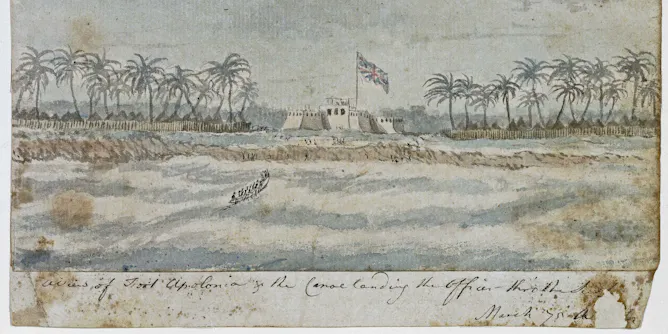
Why did Appolonia trade so few enslaved people? Short answer: unique economy and sacred beliefs.
Articles on Enslaved Africans
Displaying all articles

As many as 10% of enslaved people on St. Croix escaped. Where they went has remained a mystery, but scientists are using new mapping technology to find answers.

Iraq’s massive agricultural system, believed to have been built by enslaved Africans, has been given dates by the first archaeological study of its kind.
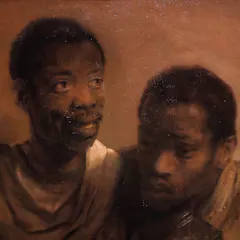
In the 1600s the Netherlands established one of the world’s first art markets – but it couldn’t have happened without the economic boom spurred by the slave trade.

A stained-glass window, which shows Jesus as a Black man for the first time, tells a story not only of race but of gender, class and ethnicity.
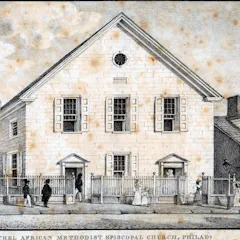
Millions of enslaved Africans were forcefully converted to the Christian faith. The Black church came about when African Americans began to establish their own congregations.

Dhamaal music and dance reveals a rich and complex mixing of cultures that is shaped by history.

A grand new memorial park walks a fine line - between teaching about slavery and becoming a tourist trap.

Geographers are documenting slave-built infrastructure, from railroads to ports, in use today. Such work could influence the reparations debate by showing how slavery still props up the US economy.

Several presidential hopefuls have offered proposals to close the racial wealth gap, from baby bonds to reparations. A simulation suggests policies short of direct aid to blacks won’t do the trick.

Reparations has emerged as a hot topic among Democratic candidates hoping to replace Trump in 2020. But until now, the issue has only rarely received national attention.

For the enslaved Africans, music – rhythm in particular – became a tool of communication about their conditions. Later, it laid the foundation for spirituals and gospel songs.
Top contributors
-

Professor of World Music, University of Connecticut
-
Postdoctoral Teaching Fellow, Princeton Theological Seminary
-
Director of African Studies, Assistant Professor of Anthropology, Kalamazoo College
-
Professor of Public Policy and Public Affairs, UMass Boston
-
Distinguished Professor of Humanities Emerita, College of the Holy Cross
-
Associate Professor, Department of Landscape Architecture and Environmental Planning, University of California, Berkeley
-
Postdoctoral Fellow at Wits Centre for Diversity Studies, University of the Witwatersrand
-
Presidential Professor of Sociology and History, Graduate Center, City University of New York
-
Professor of Geography and Senior Research Associate in the Rock Ethics Institute, Penn State
-
Starr Director of the Research and Academic Program, Clark Art Institute, and lecturer in Art History, Williams College
-
Honorary Fellow in Archaeology, Durham University
-
Assistant Professor of Anthropology, University of California, Los Angeles
-
Assistant Professor of History