

Extremist groups have pointed to the federal indictment of the Southern Poverty Law Center as proof that their worldview is correct.
Articles on Nazis
Displaying 1 - 20 of 158 articles
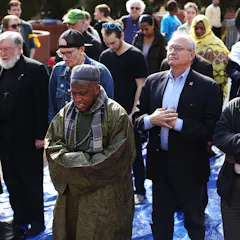
Research on social bonding suggests that common traditions can foster connection not only within communities but also across cultural and religious boundaries.

More than 800 men, branded ‘enemy aliens’ were killed when cruise ship bound for Canada was torpedoed by a Nazi U-Boat.
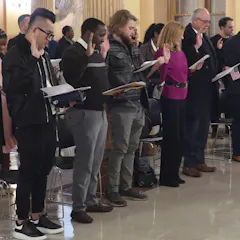
Denaturalization risks becoming a tool of political control, creating a permanent vulnerability for more than 20 million naturalized Americans.

Strategic resources have been central to the American-led global system for decades, as a historian explains. But US actions toward Greenland today are different.

On International Holocaust Remembrance Day, it’s timely to reflect on how the liberation of the camps was reported at the time – and how it changed journalism.

The claim that national security can justify territorial acquisition marks a sharp break from the principles the US championed after World War II.

The dog whistle was brought out fairly frequently in 2025 as rightwing political figures tested our limits.
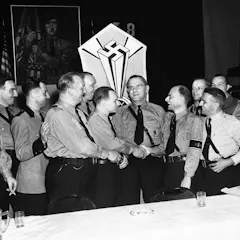
Although thousands of Americans embraced fascist ideas during the interwar years, a new study examines why the US has had little appetite to remember that past.

Despite handsome production design, almost nothing in Freddie’s story has a ring of authenticity.

Who defeated the Nazis and ended World War II? It’s a matter of disputed historical memory.
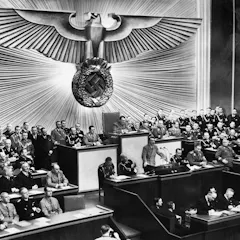
At the end of World War II, many Nazi war criminals fled to Australia. A new book tells the stories of the investigators who tried to bring them to justice.

The Ravensbrück archive reveals how being a survivor of the camps did not always entail innocence.

Historical anatomy textbooks are built on the bodies of prisoners, the poor and the powerless – and we’re still using them today.

Minnesota Gov. Tim Walz is among the politicians who have recently compared the immigration agency ICE to the Gestapo. Such analogies risk oversimplifying history.

In 1967, the Supreme Court said the government usually cannot take away citizenship without a person’s consent.

Framing antisemitism primarily as an imported problem risks strengthening forces that actively seek to undermine and ignore Germany’s confrontation with its Nazi past.

Donald Trump aims to rewrite America’s official history. George Orwell − who wrote, ‘Who controls the past controls the future. Who controls the present controls the past.“ − would recognize that impulse.

In 38 Londres Street, Philippe Sands brings to light the struggle to hold Chilean dictator Augusto Pinochet and former Nazi Walther Rauff accountable.

The Trump administration’s crusade against antisemitism looks to be mainly about crippling elite universities and blurring the lines between pro-Palestinian activism and antisemitism.
Top contributors
-

Assistant Professor of Media, Communications and Journalism, California State University, Fresno
-
Professor of History, USC Dornsife College of Letters, Arts and Sciences
-
Professor of Law and Director of the Center for Intellectual Property Law, Hofstra University
-
Associate Professor of Political Science, Marist College
-
Sherman Fairchild Distinguished Professor of History, Dartmouth College
-
Associate Professor of Sociology, University of Dayton
-
Professor of History, University of Washington
-
Professor of Modern History, University of Nottingham
-
Professor of Modern and Contemporary History, Keele University
-
Professor, Russian and East European History, University of Alberta
-
Research Assistant Professor of Nutrition Science and Policy, Tufts University
-
Professor in Law, Griffith University
-
Professor of Law and Director of the Center for Professional Ethics, Case Western Reserve University
-
Professor of Engineering Dynamics and Vibration, University of Cambridge
-
Professor of Greek, University of St Andrews