
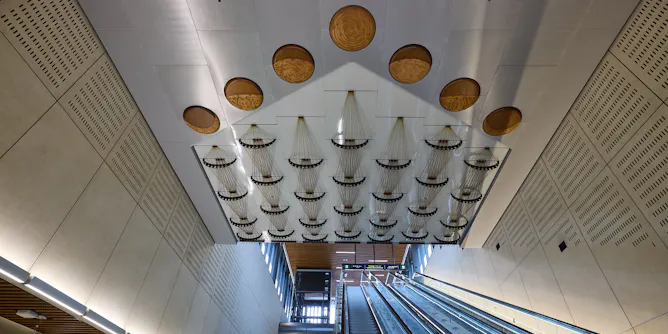
The city’s new underground rail stations are also impressive public spaces, showing how infrastructure can go well beyond the functional bare minimum.
Articles on public infrastructure
Displaying all articles

The Infrastructure Fund’s architecture undermines the expectation of full autonomy from political and executive meddling.

Men and women experience and try to cope with stress in diverse ways.

A New South Wales senate enquiry into public toilets is underway. Now’s our chance to talk about how public toilets communicate social values.

Infrastructure projects are an enticing promise for a better future – but they can also evoke a violent colonial past.

A heat wave that pushed California’s power grid to the limit, and the water system failure in Jackson, Mississippi, are just two examples.

These books offer insights into building better cities, the stories behind major inventions, and the interaction between humans and machines.

President Tshisekedi’s government no longer has the excuse that it’s being hampered by the dead hand of his predecessor Joseph Kabila’s cabal.
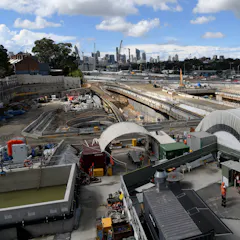
Three big firms win almost all the $1 billion-plus contracts. And they often team up in joint ventures, further reducing the competition that would keep the price tags of road and rail projects down.

The states are primarily responsible for providing infrastructure, but lack the budgets, especially since the pandemic hit revenues. Making up the shortfall depends very much on the Commonwealth.
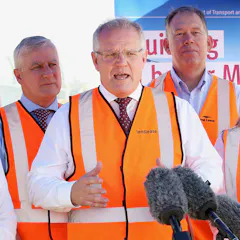
As well as an infrastructure spending boost, governments are fast-tracking approvals. But these processes exist for a reason. If we get projects wrong, we live with the consequences for decades.

Smaller projects are better for delivering broad, long-term value to communities across the country, reducing inequality and cutting emissions, as well as quickly providing jobs and economic stimulus.

States across Australia are increasingly using market-led proposals to build infrastructure. The emerging problems reflect the inherent risks of projects that bypass proper public planning processes.
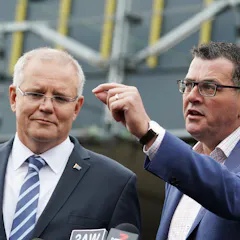
Unsolicited market proposals are not transparently assessed. Infrastructure should be built to serve the public interest, not shaped by its private backers, but the checks to ensure this are broken.

A look at the theory behind nationalising key public services, as well as what has happened in practice.

Political leaders are ignoring dangerous threats to American national sovereignty, security and citizens’ peace of mind.
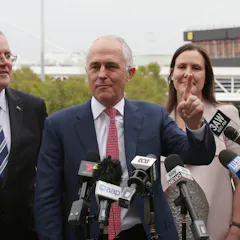
Billions of taxpayer dollars are committed before all the evidence for, and against, infrastructure projects is in. As well as missing business cases, basic rules of economic modelling are broken.

Research shows investment in large events doesn’t pay off. There are thousands of community events across Australia that offer a better bang for buck.
Top contributors
-

Associate Professor of Urban Planning, The University of Melbourne
-
Transport Fellow, Grattan Institute
-
Senior Associate, Disability Program, Grattan Institute
-
Professor of Civil Engineering, University of Colorado Boulder
-
Senior Lecturer in Urbanism, University of Sydney
-
Academic Director Living Lab Northern Rivers, University of Technology Sydney
-
Professor of Economics, Manchester Metropolitan University
-
Senior lecturer, Business Management, De Montfort University
-
Professor of Construction Management, University of Technology Sydney
-
Professor of Urban Policy and Director, Urban Futures Enabling Impact Platform, RMIT University
-
Director, Melbourne Sustainable Society Institute, The University of Melbourne
-
Honorary Senior Fellow in Transport Planning, The University of Melbourne
-
Lecturer in African History, Queen Mary University of London
-
Honorary Associate Professor in Planning, University of Queensland, University of Sydney
-
Post-doctoral Fellow, Department of Geography, University of Bonn