
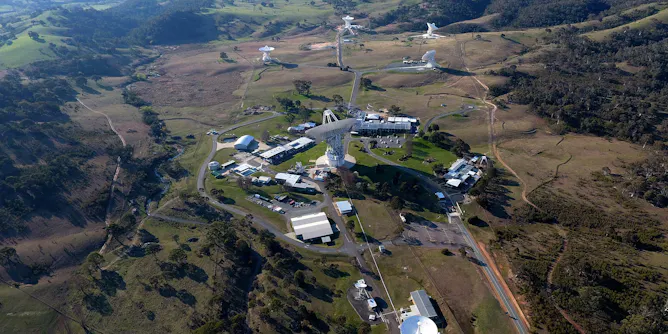
Ground stations in Australia are crucial for contacting the astronauts travelling to the Moon.
Articles on Space policy
Displaying 1 - 20 of 21 articles
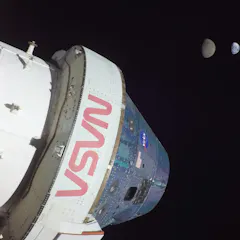
NASA’s Artemis II mission took decades of policymaking, engineering and financial support.
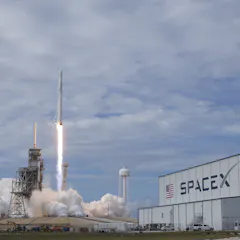
What does it mean for national security if access to Earth’s orbit depends largely on one company?
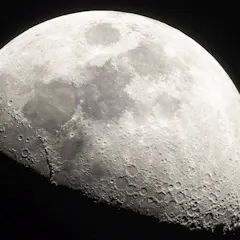
Today, there aren’t just two countries competing to get to the Moon. More countries have space programs, and private industry plays a larger role.
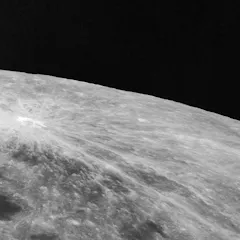
The US, China, India, Europe and Japan all have exciting missions on the horizon in 2026. Many of them are collaborative feats.
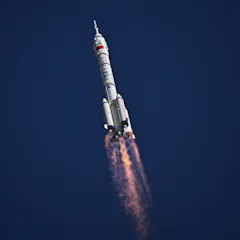
China has created more space debris than any other country. But as its space program grows, it has more to lose from a collision than ever before.
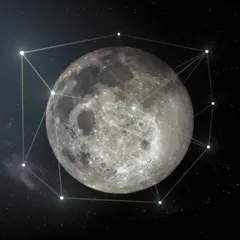
The US doesn’t currently have much ability to monitor what’s going on in the space around the Moon. An effort by the Air Force Research Laboratory could help.

As more countries look to space, experts argue that it’s worth asking why we want to go at all, and who should lead the charge.
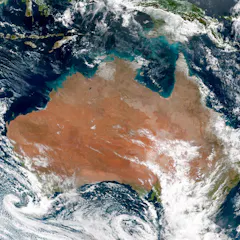
Australia relies on satellites it doesn’t own – which creates a risky situation.

Billionaire CEO Jared Isaacman has worked closely with SpaceX. He expressed an interest in sending missions to both the Moon and Mars if confirmed.

NASA administrators have hard choices to make, but the outcomes are often out-of-this-world exciting.

From creating the Space Force to blocking weapons testing in space, both Trump and Harris have extensive records on space policy to examine .
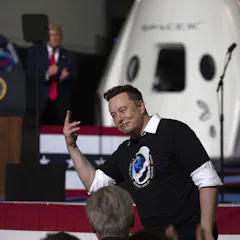
Elon Musk’s support of Donald Trump could earn him some influence over space policy if Trump wins the 2024 election.

You have the US space program to thank for some of the technology in your phone and laptop.
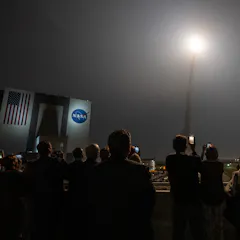
A new survey catalogs Americans’ expectations about the future of space, from NASA to SpaceX. Two space policy experts describe how these results stack up against the current state of space affairs.
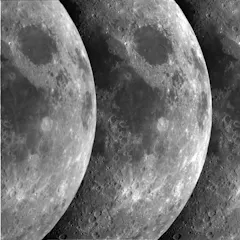
While a return to the Moon will allow the U.S. to collaborate with other nations interested in space, this endeavor is also complicated by geopolitical tensions.

As signatories, Nigeria and Rwanda are demonstrating their commitment to safe, sustainable use of outer space. This should have multiple benefits.

Spacecraft are just a small part of what it takes for humans to become an interplanetary species. A political science professor explains how there is much more to creating a spacefaring society.
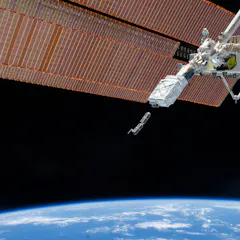
Private satellite companies have boomed in recent years, and many experts have wondered what role they would play in a conflict. They have proved to be invaluable to Ukraine in recent months.
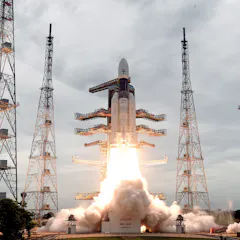
India’s Moon shot isn’t just about prestige. As launch costs fall, the space economy is poised to boom. A lengthening list of nations is eyeing the sky.
Top contributors
-

Associate Professor of International Affairs, Georgia Institute of Technology
-
Professor of Strategy and Security Studies, Air University
-
Assistant Professor of Space and International Relations, Johns Hopkins University
-
PhD candidate in international business and comparative political economy, University of Auckland, Waipapa Taumata Rau
-
Curator of the Apollo Collection, National Air and Space Museum, Smithsonian Institution; Georgetown University
-
Federal Astrophysicist and External Relations Lead at the Smithsonian Astrophysical Observatory, Smithsonian Institution
-
Professor of Air and Space Law, University of Mississippi
-
Postdoctoral Fellow in International Affairs, Georgia Institute of Technology
-
Chief Executive Officer, Australasian Centre for Space Governance; Associate Expert, National Security College, Australian National University
-
Associate Professor, School of Arts and Media, UNSW
-
Assistant Professor of Space and Society, Arizona State University
-
Adjunct Professor, University of British Columbia
-
Teaching Associate in Philosophy, School of History, Philosophy and Digital Humanities, University of Sheffield
-
Associate Professor of Aerospace Engineering, Georgia Institute of Technology
-
Assistant Professor of International Affairs, Georgia Institute of Technology