

A culture of solving political differences with conflict has led to persistent disagreements about the Ethiopian state.
Indiana University

Founded in 1820, Indiana University is one of the world’s foremost public institutions. With more than 112,000 students and 19,000 employees statewide, IU continues to pursue its core missions of education and research while building a foundation for the university’s enduring strengths in teaching and learning, world-class scholarship, innovation, creative activity, community engagement and academic freedom. Bloomington is the flagship campus of the university, and each one of IU’s seven campuses is an accredited, four-year degree-granting institution.
Links
Articles

Russia’s 2026 parliamentary elections will take place over three days, starting Sept. 18.

Large datasets can be useful research tools, but current government efforts to gather medical records depend on policy and technology that falls short of protecting people’s privacy.

Warmer ocean waters are fueling the spread of the bacteria Vibrio vulnificus. Infections can lead to a rare but fatal condition called necrotizing fasciitis.

His achievements as a philanthropist are not widely known today because he did not create a grantmaking foundation that outlasted him.

License plate readers are widely used in the US. A new product marketed to police departments promises to add the ability to sense phones and other devices in passing cars.

A Commerce Department order requiring Anthropic to wall off its most advanced AI models from foreign nationals could be the government’s attempt to keep the best AI technology for itself.

Research shows that losing coverage, even temporarily, tends to make people less healthy, and it exposes them to financial losses.

Giving that’s associated with the wealthiest Americans – from bequests and foundations to universities and donor-advised funds – fared better than usual.

There are opportunities at every level of the US energy market to save consumers money – if governments, companies, communities and individuals choose to act.

In parliamentary democracies, prime ministers remain in office for as long as they retain the confidence of parliament.
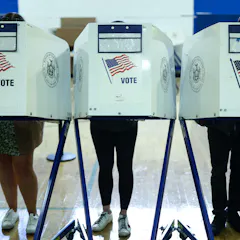
The federal task force that defends US elections has been largely absent this election cycle, and the threat-sharing hub it relied on has been defunded.

The EPA’s new interpretations are strategically designed to appeal to the current US Supreme Court’s view of agency authority.

Opponents of guaranteed-income programs often argue that recipients will simply take the money and be less motivated to do any work whatsoever.

Research shows discrimination often reduces civic engagement among marginalized groups. These women are bucking that trend.
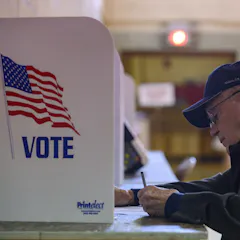
Since voters live longer, casting a ballot may be seen as another healthy habit, like going for a run or eating lots of vegetables.

It’s unusual for federal authorities to take this kind of action when federal funding is not involved. And the SPLC does not accept government grants.

Medicaid enrollment surged during the pandemic, then tumbled during the Great Unwinding – reflecting how paperwork and state policy determine who keeps health coverage.

Three questions can help patients get a better handle on drug and health care options. But many Americans still hold back from asking providers for information.

Victor Glover will become the first Black astronaut to orbit the Moon – but he is part of a long line of Black explorers, many forgotten through history. New research is giving York his due.
Authors
-

Ph.D. Fellow, Center for Constitutional Democracy, Indiana University
-
Associate Professor of Health Policy and Management, Indiana University
-
Professor of Microbiology and Immunology, Indiana University
-
Lynton K. Caldwell Professor of Public Affairs, Indiana University
-
Professor of Public and Environmental Affairs, Indiana University Indianapolis
-
Visiting Professor of Law and Environmental Affairs, Indiana University
-
Professor of Law, Indiana University
-
Associate Professor of Public and Environmental Affairs, Indiana University
-
Interim Director of Data & Research Partnerships at the Lilly Family School of Philanthropy, Indiana University
-
Associate Professor of Law, Indiana University
-
Professor Emeritus of Public affairs and Philanthropic Studies, Indiana University
-
Ph.D. Candidate in Geography and Assistant Director at the Center for Refugee Studies, Indiana University
-
Professor of Political Science, Indiana University
-
Professor of Business Law and Ethics, Indiana University
-
Professor of Philanthropic Studies, Indiana University