
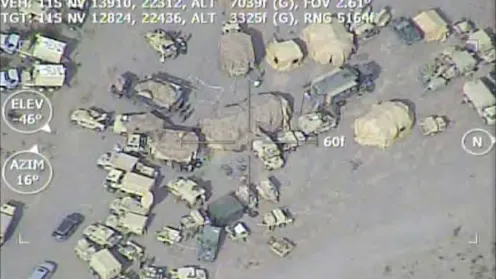
Today’s military commands struggle to manage battlefields that span cyberspace and outer space, as well as land, sea and air. AI is poised to help by breaking them out of their centuries-old structures.
- Professor of Strategic Studies at the Marine Corps University School of Advanced Warfighting; Scholar-in-Residence, American University School of International Service

The audacious drone assault of June 1 may have destroyed one-third of Russia’s long-range strike fleet. But the implications are potentially much bigger.

Even if US financial aid is restored, Ukraine will have to mitigate the risk of future disruption – and that could mean a more timid approach.

L’autorisation de missiles à longue portée par l’administration Biden doit être vue comme un effort pour contrer le renforcement des troupes russes, soutenues par des troupes de Corée du Nord.

The authorization of longer-range missiles by the Biden administration is seen as an effort to counter a buildup of Russian troops supported by fighters from North Korea.

The Taliban and the Islamic State group are among the militant groups that have been known to use civilians as human shields in the past, in order to try to shift their opponents’ war calculations.

Russia and Ukraine have blamed each other for the attack on crucial civilian infrastructure. Experts explain what the incident means for future war plans, and for the safety of the affected region.

In the face of Russian military setbacks at the hands of a dogged opposition army, Russian President Vladimir Putin is focusing on targets that will put psychological pressure on the Ukrainian nation.

A military strategist breaks down how a smaller Ukrainian army has successfully taken back swaths of land from the Russians in the country’s northeast.

In the murky world of cyber espionage and cyber warfare, effective deterrence has long been considered out of reach. A government report argues it’s time to change that.

A defender that can hold out while inflicting greater losses on its attacker can wear down an adversary – reducing the threat of additional attacks.

A new strategy for U.S. Cyber Command seeks to block enemies from achieving their objectives – but may not be successful, and could have unforeseen consequences.
Contact Benjamin for
- General
- Media request
- Speaking request
- Consulting / Advising
- Research collaboration
- Research supervision
- Location: Washington, D.C., U.S.
- Article Feed
- Joined

