
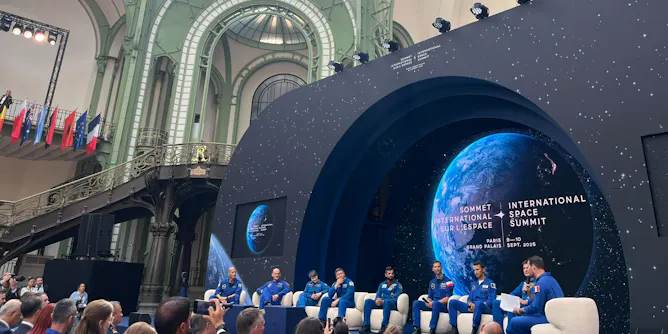
Paris’ International Space Summit was an opportunity to understand what and who Europe needs to reliably sustain its launch ambitions and become a world-class leader in Space.
Articles on Aerospace
Displaying 1 - 20 of 45 articles
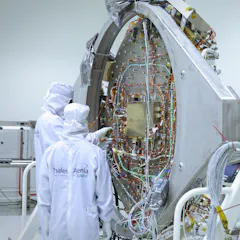
Europe’s leading aerospace industry players have no choice but to work hand in hand to further its space missions and develop critical infrastructure for security and climate protection.

With a half-billion-dollar loan, the US hopes to cut its reliance on Chinese supplies of scandium, a crucial mineral for aerospace. But China still has leverage.
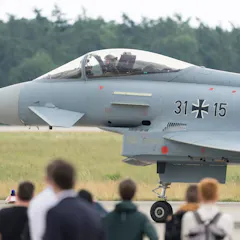
Understanding the coopetition mechanics behind Europe’s defence dilemma is vital and key for making much-needed headway.
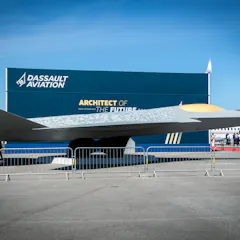
The collapse of the Future Combat Air System programme led by France and Germany highlights how diverging national interests and coordination difficulties are challenging European armament cooperation.

NASA has several contracts with Blue Origin as part of its Artemis program – this setback for the company could delay the program.

Planned ‘megaconstellations’ of satellites could cause unforeseen harm to the ozone layer and climate systems. Global regulation is needed before it’s too late.
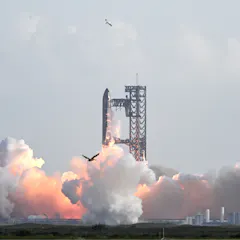
NASA, SpaceX and Blue Origin have all successfully launched superheavy-lift rockets. These massive vehicles are designed to carry a much heavier load.
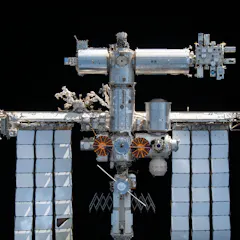
Archaeologists have studied how astronauts use the International Space Station to improve its potential future successors.
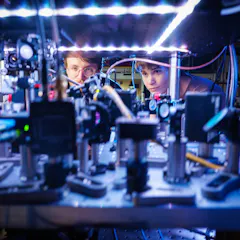
Federal funding cuts in the billions have impacted dozens of universities in the US.

The government hopes that by focusing on sectors that drive growth it will attract investment and boost prosperity.
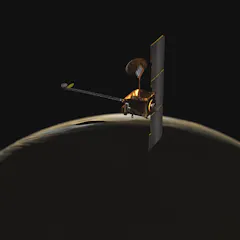
An aerospace engineer explains why NASA, Space Force and other agencies are using or testing aerobraking for more fuel-efficient spacecraft.

The fighter jets are likely to incorporate AI, as well as advanced engine and stealth technology.

Italian companies have a stake in the future defence architecture of Europe.
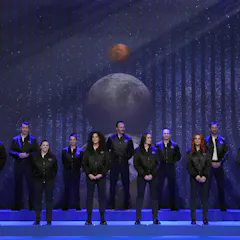
Figuring out how to make spacecraft more accessible to astronauts with physical disabilities can also make them safer for long-duration missions.
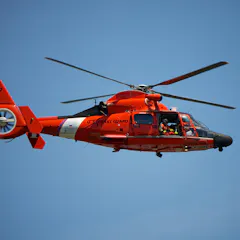
Advances in technology, training and maintenance have helped make an inherently challenging vehicle – rotorcraft – safe.
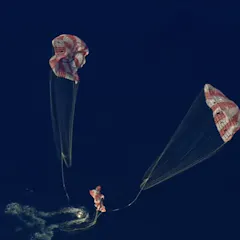
Safely landing a spacecraft that’s falling from the sky very quickly is easier said than done.

People have been flying airplanes for well over a century. Engineers know how to balance all the forces at play, but still aren’t exactly sure how some of the physics of flight actually works.

When you’re an astronaut landing on the Moon, you can’t rely on the same gravitational cues we have on Earth. But regimented training with sensory devices could one day prevent spatial disorientation.
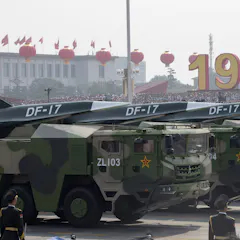
China’s newest hypersonic missile, the DF-27, could sideline US aircraft carrier groups in the Pacific, while missiles in the works in China, Russia and the US threaten global security.
Top contributors
-

Director of the Center for National Security Initiatives and Professor of Aerospace Engineering Sciences, University of Colorado Boulder
-
Enseignante-chercheuse en Management Stratégique, Montpellier Business School, Montpellier Business School; European Academy of Management (EURAM)
-
Senior Lecturer in Aerodynamics, Northumbria University, Newcastle
-
Associate Professor of Aviation and the Environment, Cranfield University
-
Senior Lecturer in Networking, The Open University
-
Director of Transport Systems, Professor of Safety & Accident Investigation, Cranfield University
-
Centre for Advanced Electrical Drives, Newcastle University
-
PhD Candidate in History of Mathematics, The Open University
-
Senior Lecturer in Fluid Mechanics, University of Portsmouth
-
WW Tech Lead, CAE, University of Oxford
-
Director of Education and Senior Lecturer in Renewable Energy, University of Exeter
-
Senior Lecturer, Department of Computing and Communications, The Open University
-
Emeritus Professor of Economics, University of the West of England
-
Research Scientist, Brandeis University
-
Professor of Operations Management, Warwick Business School, University of Warwick