
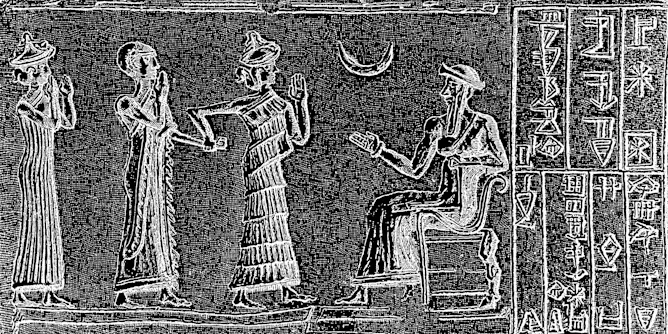
Science uses careful, organized observations and tests to construct theories that are recorded, passed on to others and built on.
Articles on Babylon
Displaying all articles

Using a sheep’s liver to predict the outcome of the US election makes a serious point about how humans have coped with uncertainty throughout history.
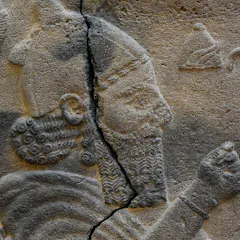
To protect their kings, ancient Mesopotamians discovered how to predict eclipses, which were associated with the deaths of rulers. This eventually led to the birth of astronomy.
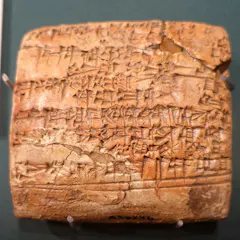
Mesopotamia’s prisons were built for detaining people, not punishing them. But they shaped powerful ideas about justice and reform that aren’t so different from today’s.
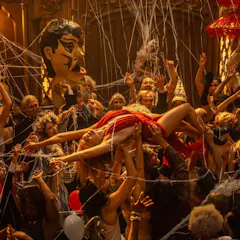
Both Babylon and The Fabelman’s were nominated for Academy Awards for best score – and both take opposing but equally successful approaches evoking nostalgia.
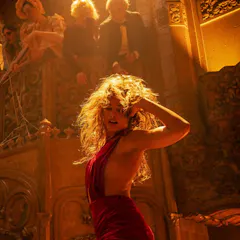
Damien Chazelle’s new film Babylon has both relevance and resonance today.

Enormous, scaly, fire-breathing dragons have fascinated civilizations for centuries. A scholar who studies monsters explains their power and appeal.

The Bible and its laws were complex and not practiced in the way many of us think about laws today.

Believed to possess magical qualities, amulets were once widely used. They range from amber pendants worn during Denmark’s Mesolithic age to wind chimes found at Pompeii.

What did Pythagoras do with all those triangles, anyway?

A Christian movement led by independent religious entrepreneurs, often referred to as ‘apostles,’ is changing the religious landscape of the US.
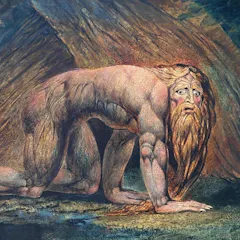
Nebuchadnezzar was a warrior-king of the Neo-Babylonian empire. And now, Kanye West has written an opera inspired by him.

From the Bible to Versailles, gardens are bound to their political and religious history.
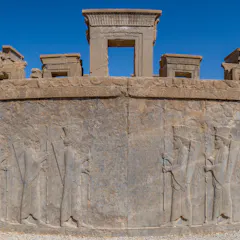
Cuneiform was used for over 3,000 years in the Ancient Near East, but was only decoded in the 19th century. The writing form is still revealing amazing stories, from literature to mathematics.
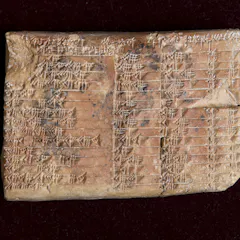
A 3,700-year old Babylonian clay tablet reveals an ancient method of constructing right-angled triangles that makes it the world’s oldest and most accurate trigonometric table.

More than 2,000 years ago, the Babylonians understood the cycle of eclipses. They also regarded them as signs that could foretell the death of a king.
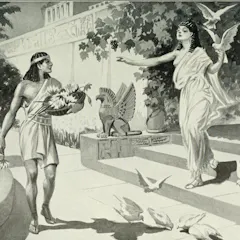
Love, it is said, is a battlefield, and it was no more so than for the first goddess of love and war, Ishtar. Her legend has influenced cultural archetypes from Aphrodite to Wonder Woman.

More than three decades after his death reggae icon Bob Marley’s music remains meaningful. It still has the potential to catalyse conversation not often had in the postcolonial world.
Top contributors
-

Honorary Research Associate, Department of Classics and Ancient History, University of Sydney
-
Senior lecturer, UNSW
-
Assistant Professor of Psychology, Antioch College
-
Associate Professor in Mathematics, UNSW
-
Professor Old Testament and Ancient Near Eastern Studies, Reformed Theological Seminary
-
Executive Director, Center for Religion and Civic Culture, USC Dornsife College of Letters, Arts and Sciences
-
Professor, Classics and Archaeology; Philosophy, Queen's University, Ontario
-
Associate Professor of Religious Studies and Jewish Studies, University of Colorado Boulder
-
Senior Lecturer, School of Music, University of Auckland, Waipapa Taumata Rau
-
Professor of Sociology, Biola University
-
Associate Professor, University of Auckland, Waipapa Taumata Rau
-
Instructor in English, Arizona State University
-
Honorary Professor of Classics and Ancient History, School of Historical and Philosophical Inquiry, The University of Queensland
-
Lecturer in the Heritage of the Middle East, University of Leicester
-
Associate Professor of Classics & Ancient Mediterranean Studies, History, and Asian Studies, Penn State