

Russia’s use of the Oreshnik nuclear missile extends beyond a single weapons system — its underlying logic is to terrorize civilians, not to deter Ukrainian retaliation.
Articles on Chernobyl
Displaying 1 - 20 of 60 articles

Svetlana Alexievich is Belarus’ only Nobel Laureate – but the exiled journalist’s work is suppressed within her own country.
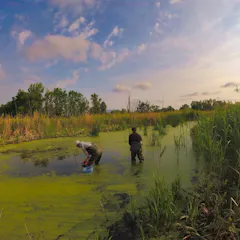
Chernobyl’s exclusion zone has become one of Europe’s biggest nature reserves.

Can we ever really understand Chernobyl? These five shows and videogames give a pretty good glimpse of what the disaster entailed.

What does the wealth of books, documentaries and dramas about the Chernobyl disaster tell us that history alone cannot?

Is radiation really changing Chornobyl’s dogs? It’s a great story, but not supported by evidence.

Once classified files from East Germany reveal the extent of Soviet actions to hide the true extent of catastrophe.

The nuclear incident at Chernobyl spread radiation across Europe and led to political changes that played a role in the collapse of the Soviet Union.

Radiation risk can be measured, understood and controlled in ways that keep people safe, including from contaminated foods.

Endangered species are making their home in a massive wild zone around the derelict Chernobyl nuclear plant.

Radiation exposure does not affect the life expectancy or health of frogs living in Chernobyl’s exclusion zone.

Fission and fusion are both nuclear reactions. But while one involves splitting atoms, the other involves fusing atoms together.

Russia is committing ecocide in Ukraine, an act of war aimed at inflicting serious damage on the environment.

What if plants in the area surrounding a nuclear reactor could act as radiation detectors, with the help of a drone?

When Australia’s government and opposition argue over how to get to net zero emissions, nuclear power is the flashpoint. The argument against nuclear is stronger, but not for the obvious reason.

Zircons formed in the hellish Chernobyl meltdown are changing how geologists understand their favourite crystals.

In this week’s episode of The Conversation Weekly, we speak with three scientists who study the ways plants and animals evolve in a world dominated by humans.

Research on Chernobyl frogs has shown that the ionising radiation caused by the accident triggered a process of natural selection among these animals.
The conflict highlights the folly of nations exiting nuclear power while continuing to use coal, gas and oil.

The level of danger posed by the Chernobyl power cut depends on how long it lasts.
Top contributors
-

Profesor Titular de Zoología / Associate Professor of Zoology, Universidad de Oviedo
-
Reader in Applied Ecology, University of Salford
-
Directeur du Centre de recherche sur les risques et les crises et chercheur au sein du Collège des Sciences Navales, Mines Paris - PSL
-
Investigador postdoctoral Juan de la Cierva Incorporación, Estación Biológica de Doñana (EBD-CSIC)
-
Professor of Environmental Science, University of Portsmouth
-
Professor of Biological Sciences, University of South Carolina
-
Research Fellow in nuclear waste disposal, University of Sheffield
-
Professor of Intelligent and Self-Organising Systems, Imperial College London
-
Lecturer in Peace Studies and International Development, University of Bradford
-
Associate Professor, Creative Writing, The University of Melbourne
-
Sociologue, IMT Atlantique – Institut Mines-Télécom
-
Post-doctoral Teaching Fellow in Literature & Languages, University of Stirling
-
Professor of English, University of Sussex
-
Timothy J. Jorgensen is a Friend of The Conversation.
Director of the Health Physics and Radiation Protection Graduate Program and Professor of Radiation Medicine, Georgetown University
-
Deputy Section Head Section of Environment and Radiation at IARC, International Agency for Research on Cancer (IARC)