
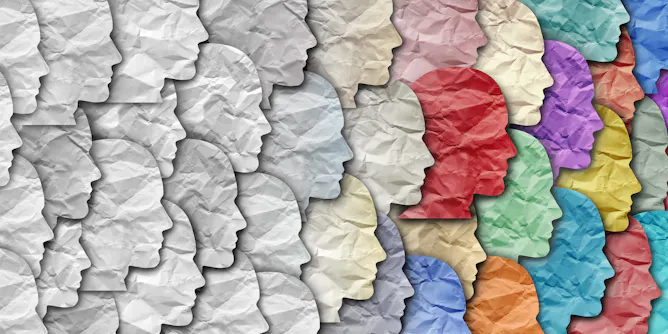
After backlash from the LGBTQIA+ community, the government agreed to include gender and sexual orientation questions in the new census. So why not intersex?
Articles on Data collection
Displaying 1 - 20 of 97 articles

To augment information about you that it collects directly, the US Government is buying less-regulated information harvested by cameras, cellphones and apps and sold on the commercial data market.

Aerial lidar raises ethical questions because it can collect data remotely without the knowledge or consent of Indigenous and descendant populations that are on the ground.

Your data is being collected and served back to you in a fun way. You might be limiting you taste in following its design for you.
A privacy researcher breaks down how your phone reveals your location, how that data is collected and sold, and how the government gets ahold of it – by simply buying it.

How people talk about data privacy can overcome – or reinforce – their skepticism that things can change.

The lack of data about insect life in Australia is already having consequences for plants, animals, and even people.

The federal government has erased gender identity questions from federal surveys. Researchers say it will cost them at least a decade’s worth of data.

The government, because it takes the lead in implementing official policies, is in a unique position to collect and store sensitive data collected over long periods of time.

If privacy is important anywhere, it is in the context of politics. If it is important at any time, that time is now.

The Trump administration’s CDC data purge means researchers can no longer effectively track and address health issues affecting LGBTQ+ people – and ultimately society as a whole.

C-65 would help political parties exploit Canadians’ data without real limits, transparency or consent. This could undermine privacy, engagement and confidence in political parties.

After receiving dozens of unwanted calls from telemarketers, I started to investigate.

The government has decided against including questions about sexuality and gender identity in the 2026 Census. How can it make policy for LGBTQI+ people without such basic data?

Governments should play to their existing strengths in data collection to make AI safer for their citizens, including assessing what kinds of data are too risky to allow private companies to collect.

The UK lacks a comprehensive system for recording hateful graffiti and imagery, something which researchers argue must change.

Existing regulations do not go far enough in protecting people’s information from being collected and shared when they visit websites.
It’s no surprise that corporations harvest vast amounts of data about people, but documents in an FTC lawsuit detail the stunning amount that data brokers know about you and everyone else.

Citizen data that is reliable for use at a national, regional or sub-regional scale does not automatically offer accurate portrayals of specific local and community conditions.

The draft bill has a number of issues, ranging from an insecure mechanism that leaves people’s data vulnerable to attacks, to a lack of mandatory disclosure of data breaches.
Top contributors
-

Associate Professor, School of Law, University of Canberra
-
Professor and Canada Research Chair in Communication Policy and Governance, McMaster University
-
Affiliated Faculty Member, Institute for Computational and Data Sciences, Penn State
-
Reader in Sociology, Cardiff University
-
Professor of Internet Studies, Curtin University
-
Senior Lecturer in Politics and Sociology, Swinburne University of Technology
-
Associate Professor, School of Engineering, RMIT University
-
Postdoctoral Fellow, Centre for Transformative Media Technologies, Swinburne University of Technology
-
Research associate in environmental governance, Cardiff University
-
Professor in science and technology studies, Cardiff University
-
Professor of Marketing, University of Sydney
-
Research Assistant, Faculty of Law, Queensland University of Technology
-
Associate Professor in the School of Computer Science, Northumbria University, Newcastle
-
Professor, Director: School of Consumer Intelligence and Information Systems, University of Johannesburg
-
Deputy vice-chancellor (Research), Edith Cowan University