

In 2013, anthropologist David Graeber wrote an article for an obscure, left-wing magazine. It spawned a book – and a turn of phrase – that became a cultural phenomenon.
Articles on John Maynard Keynes
Displaying 1 - 20 of 43 articles
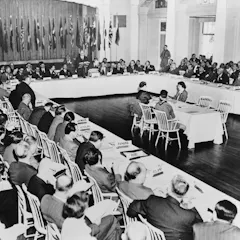
The 1944 conference to create a post-war international monetary system marked the beginning of America’s global dominance.
Both should work hand in hand to ensure the best outcomes for the economy as a whole. But they operate quite differently.

Championed by Thatcher, Reagan and Elon Musk, there’s a marked tendency to reduce Hayek to less than the sum of his parts.

In 1930, economist John Maynard Keynes famously predicted that within a century, the normal workweek would decrease to 15 hours. Why was he wrong?

The Scottish economist dedicated his life’s work to understanding the consequences – moral, social and political – of capitalism. Both neoliberals and leftwingers claim his legacy.

As a young investor, the founder of modern macroeconomics John Maynard Keynes might well have bought Bitcoin. The older Keynes would not have. It’s instructive to examine why.

Three stories from Australia and the UK exploring the role of art in helping people deal with the challenges life throws at them. Listen to The Conversation Weekly podcast.

China has given itself a major advantage over India by constructing a massive road network in the past two decades.

Rethinking capitalism requires that the primary focus should be on the distribution of economic power as the potential leading causal factor driving inequality.

The task now is to turn the reactive response to the health and economic emergencies into a proactive set of policies and actions.
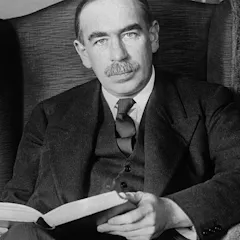
The English economist’s views on “animal spirits” are vital to understanding his work.

Massive stimulus plans combined with rising production costs could lead to expectations that inflation will rise. And that alone could trigger an inflationary spiral not seen in 25 years.
Whether the next pandemic bailout bill is called relief or stimulus depends on what ails the US economy – and maybe it doesn’t matter at all.

The Australian government’s spending is Keynesian, but its approach to wage growth is not.

While necessary during the crisis, government borrowing isn’t costless. Longer term, it might depress living standards.

If there is one lesson from history, it is that the economy will pick up again.

An audio version of an in depth article on four possible futures for the world after coronavirus.

The prosperity and happiness of one country promotes that of others. That’s a lesson Donald Trump has never learned.

An economist unravels the seeming contradiction between stocks flirting with all-time highs and growing fears of a recession.
Top contributors
-

Professor of International Relations, Australian National University
-
Senior Lecturer in Economics, Bournemouth University
-
Senior lecturer, Canberra School of Government, University of Canberra
-
Distinguished Professor and Derek Schrier and Cecily Cameron Chair in Development Economics, School of Economics and Business Sciences, University of the Witwatersrand
-
Associate Teaching Fellow, Sociology, Deakin University
-
Lecturer in Theatre, University of Bristol
-
Associate Professor of Economics, University of South Carolina
-
Principal and Vice Chancellor, University of Glasgow
-
Associate Science Editor & Co-Host of The Conversation Weekly Podcast, The Conversation
-
Professor of Economics, University of Aberdeen
-
EPSRC Research Fellow in Complexity Science, University of Sussex
-
Professor of Economics, Monash University
-
Lecturer in Management and Organisation Studies, Manchester Business School, University of Manchester
-
Postdoctoral Research Fellow - Creative Arts Research Institute - Griffith University, Griffith University
-
Professor of Economics; Head of School, University of Reading