
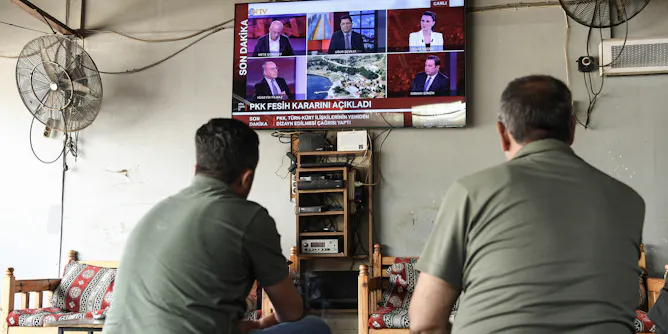
The PKK has been fighting the Turkish state for more than 40 years. Whether peace can take root will depend on each side’s commitment to a credible peace process.
Articles on PKK
Displaying 1 - 20 of 34 articles

PKK disarmament could mark a new era for the Kurds, but the situation has regional implications.
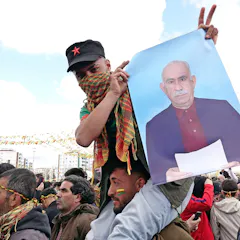
PKK’s decision to disarm and disband can provide lessons for other countries facing insurgencies.
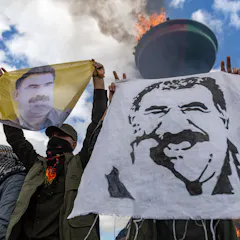
There are clear reasons for both the Turkish state and the PKK to come to the negotiating table now.

While economic and security crises coincide with an uptick in terrorist activity, the opposite is true when it comes to natural disasters.
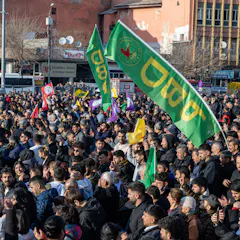
Listen to political scientist Pinar Dinc explain what’s led to the PKK’s ceasefire with Turkey on The Conversation Weekly podcast.

The PKK leader’s calls for the group to disarm and dissolve is a step towards ending a 40-year conflict with the Turkish state.

Turkey walks a fine line between NATO commitments and Western alliances and its dependence on Russia for financial resources and trade.
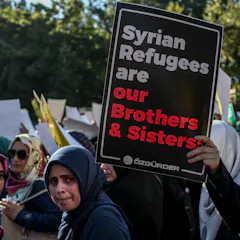
What are the drivers behind violent attacks against minorities in Turkey?
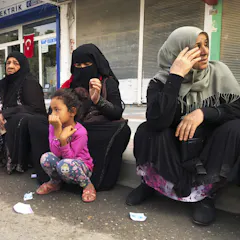
Turkey is threatening to send 3.6 million refugees back to the Syrian territory it just invaded. Deporting these vulnerable people would make them the collateral damage of a chaotic, many-sided war.

By burying the Kurdish conflict, Turkey has made it that much more difficult to resolve.

Since defending northern Syria from the Islamic State, Kurdish people have established an egalitarian society where women are equal, democracy is direct and religious freedom is guaranteed.

Why did negotiations between the Turkish state and the Kurds, aimed at mitigating ethnic conflict and bringing about peace, fail in Turkey?
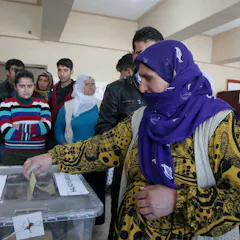
With President Erdoğan increasingly empowered, the ‘Kurdish question’ is at the forefront once again.

Ankara’s real target in Syria is the Kurds, but is Turkey getting bogged down on too many fronts?

Turkey is recovering from a failed coup, not a war, but it could learn from the practice of post-conflict reconstruction.

Politically unstable and bordering the world’s most violent and volatile region, Turkey is at risk of descending into civil war.
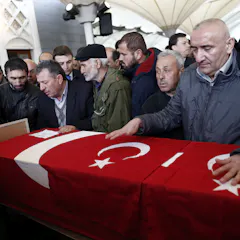
A second bomb in the Turkish capital in three weeks raises the question of who are the main players in the violent struggle.

Beleaguered president may about to receive an unequivical message from voters.
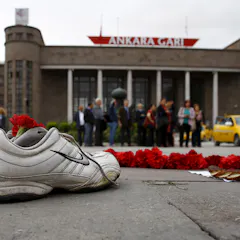
During the unrest of the 1990s, mysterious networks were said to have assassinated Kurdish fighters. Some believe they are still in operation.
Top contributors
-

Dean of Jimmy and Rosalynn Carter School for Peace and Conflict Resolution, George Mason University
-
Associate Lecturer, Faculty of Social Science, The Open University
-
Associate Professor of Political Science, Department of Political Science and Researcher, Centre for Advanced Middle Eastern Studies, Lund University
-
Associate Professor of International Relations, University of Sussex
-
Assistant Professor, Department of International Studies, University of Oregon
-
Postdoctoral Research Fellow in Politics, University of Sheffield
-
Associate professor, London Metropolitan University
-
Lecturer in Middle East & Mediterranean Studies, King's College London
-
UKRI Postdoc Fellow in International Relations, University of Sussex, School of Global Studies, University of Sussex
-
Sessional Academic, School of Social Sciences, Macquarie University
-
Research Associate, School of History, Politics and International Relations, University of Leicester
-
Professor in Political Science and International Relations, Durham University
-
Associate Professor in International Politics, UCL
-
Phd Student and Graduate Teaching Assistant in Politics, University of Essex
-
Postdoctoral research fellow, Queen Margaret University