
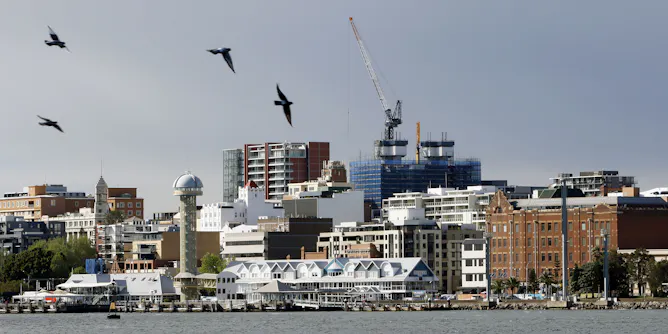
Being sold off is the best news the staff and readers of the Newcastle Herald have had for a long time.
Articles on Regional Australia
Displaying 41 - 60 of 96 articles

In the early 20th century, voters in rural Australia began to organise politically for the first time – and proved crucial to the ousting of the reformist Labor government in 1913.
Population growth has pros and cons, and the Morrison government’s plan is less about a change in immigration numbers than about increasing the benefits and minimising the costs.

Capital city populations are growing twice as fast as the rest of Australia, because of the employment and business opportunities and lifestyle on offer to both new migrants and long-term residents.

Encouraging migrants to move to regional areas could be a win-win’ scenario, as long as policymakers pay attention to five key factors.

Rural and regional Australia is a big and diverse place, but some broad common issues do emerge as policy priorities.

Research shows there are now more ministers responsible for regional issues across Australian governments than ever before.

After waiting eight months for the government response to a major report on regional Australia, the outcome has been underwhelming, sticking to the same old ideas.

The industrial patterns of mining shaped many Australian towns, which found varied uses for disused mine sites. The mining boom ensures the challenges these sites present will be with us a long time.

Grey nomads travel Australia because they have the desire and the means to do so. Could future generations end up following in their footsteps because they can no longer work and stay in one place?

The Canadian immigration model shows that giving states and territories a say in immigration policy can help take the pressure off major urban areas.

Efforts by governments to redirect population growth to regional Australia have never worked. Even if such policies could be made to work, they probably wouldn’t be worth the costs.

We read about and watch other people moving to the coast or country and, in doing so, sometimes we’re persuaded to join the seachangers and treechangers ourselves.

Even in the age of digital disruption and big-name mergers, there are signs that local newspapers remain viable and strong.

A new parliamentary report has taken an informed and sensible approach to developing regional Australia, without simply focusing on the contentious issue of decentralisation.
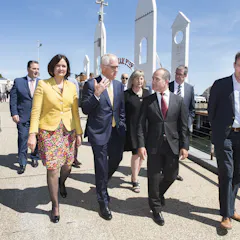
With the emerging emphasis on regional City Deals and Smart Cities funding, perhaps Australia is beginning to find its way to a national cities policy, rather than just a big cities policy.

Growth in high-skilled jobs is highest in Australian cities and for the country its low-skilled jobs.

The big ticket resources projects of the past decade have not delivered as hoped for regional Queensland. New approaches are needed.

Innovation is focused on regional centres that have research and development institutions, but more than 150 regional areas have potential to match this innovation, research finds.

Knowing a city’s professional network ratio helps to understand how connected its inhabitants are to other markets, customers and ideas. All support innovation, adaptation and city growth.
Top contributors
-

Associate Professor, University of Canberra, Stockholm Environment Institute
-
Director, The Cairns Institute, James Cook University
-
Senior Lecturer in English Literature, Charles Sturt University
-
Professor (Communication), Deakin University
-
Lisa Waller is a Friend of The Conversation.
Professor of Digital Communication, RMIT University
-
Deputy CEO, Regional Australia Institute
-
Executive Dean, UniSA Business, Adelaide University
-
Postdoctoral Research Fellow, Sustainable Urban Precincts Project, RMIT University
-
Lecturer in Entrepreneurship, Innovation and Organisational Design, RMIT University
-
Professor of Media and Communication and Co-Director, Digital Ethnography Research Centre, RMIT University
-
Professor of Social Economics, UTS Business School, University of Technology Sydney
-
Honorary Professor of Demography, Macquarie University
-
Associate Director, Government Relations, Australian Catholic University
-
Associate Professor and Clinical Psychologist, Charles Sturt University
-
Director, Gilbert + Tobin Centre of Public Law, UNSW