

Tsetse flies move between a broad range of animals. They connect wildlife, livestock and humans in complex transmission networks.
Articles on Tsetse fly
Displaying all articles
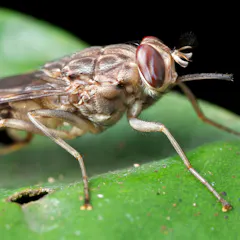
New research on what attracts blood-feasting flies to blue objects could help minimise the impacts of those insects on people and animals.
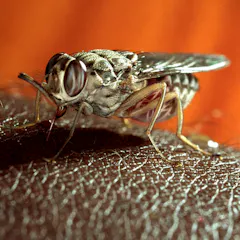
This insect’s unique reproductive biology could lead to new ways to control the species in the environment – and prevent the deadly sleeping sickness it spreads to people.

From fungi and flies to spiders and fish, living collections need care and feeding even when their human keepers are dealing with a pandemic and its resultant social distancing.

Mathematical modelling tools may predict where tsetse flies are being driven to extinction.

How the zebra got its stripes is not only a just-so story, but an object of scientific inquiry. New research suggests that stripes help zebras evade biting flies and the deadly diseases they carry.

A new finding may shed light on how sleeping sickness has avoided elimination and could help finally beat the deadly disease.

New research upends the previous theory that tsetse flies – and the disease they carry – were the main reason the spread of livestock domestication in Africa stalled out for a thousand years.
Top contributors
-

Research Associate at the Institute of Biodiversity Animal Health and Comparative Medicine, University of Glasgow
-
Graduate Teaching Assistant in Biology, University of Utah
-
Wellcome Trust Senior Research Fellow at the Institute of Biodiversity Animal Health and Comparative Medicine, University of Glasgow
-
Assistant Professor of Entomology and Nematology, University of California, Davis
-
Lecturer in Zoology, Aberystwyth University
-
Professor of Biology, West Virginia University
-
Research Fellow in Biological Sciences, University of Bristol
-
Postdoctoral Researcher in Mycology, West Virginia University
-
Associate Professor of Mycology and Plant Pathology, West Virginia University
-
Senior Research Fellow, South African Centre for Epidemiological Modelling & Analysis (SACEMA)
-
South African Centre for Epidemiological Modelling & Analysis (SACEMA)
-
Professor, School of Biological Sciences, University of Bristol
-
Head of Global Health Thematic Research Programme, International Centre of Insect Physiology and Ecology
-
Chair and Professor of Cell and Developmental Biology, Julius Maximilian University of Würzburg