
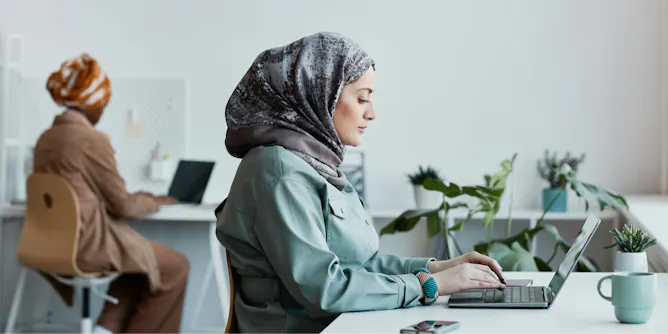
A pilot study drawing on 2021 Census data found that Muslim workers in the Greater Toronto and Hamilton Area earn significantly less than non-Muslim counterparts.
Articles on Workplace equality
Displaying all articles

New research finds that people consistently describe women as detail-focused and men as visionary, a bias with measurable consequences for who gets promoted.

While blatant discrimination is easy to condemn because of how obvious it is, there are subtler, more insidious forms that also need to be rooted out.

Many people with disabilities in Canada still face systemic barriers. Governments must take action to reduce inequities.

True workplace diversity goes beyond visible diversity and also includes diversity of personalities, values and attitudes.

Voluntary regulation has helped company boards become more diverse but has been more successful in certain countries.

Corporations have the responsibility to make workplaces more inclusive and welcoming for LGBTQ+ employees.

Many large employers must already report statistics on issues such as how many women they employ, their pay and their level of seniority. But that’s not enough; an intersectional approach is needed.

Women suddenly saddled with increased caregiving duties – whether for children or elderly parents – have been forced to reduce their hours, which hurts their careers and lifetime earnings.
The voices and work of leading Muslim women are proving to be pivotal in changing the landscape of gender, race and religious inequalities.

We could expect a change in language to decrease gender disparities across a host of measures, including wages, educational attainment, and leadership positions in corporate and political life.

At the Golden Globes, Oprah Winfrey assured girls that the harassment scandals of 2017 will eventually lead to a brighter future. But deep workplace issues will have to be addressed first.

Sexism has long been an unfortunate feature of the workplace, but is male privilege still a problem when the gig economy makes most of our office interactions virtual?

Interventions designed to fix women also leave the status quo untouched. They ask women to adjust to workplaces that are primarily designed by, and for, men.
The continued presence of homophobic attitudes in society and the workplace has been eroding the productivity and profitability of Australian businesses.

Many children who cross the U.S. Mexico border illegally remain undetected and must fend for themselves on the other side.

The escalating indifference with which Uber allegedly reacted to a software engineer’s harassment claims is the norm in the corporate world, where enforcing civil rights laws is seen as a tax on profits.

Many research universities have adopted ‘family-friendly’ tenure rules to help women balance family and career. However, men, not women, seem to benefit from having the extra time.
Top contributors
-

Professor of Law, University of Oregon
-
Ph.D. Student, University of California, Santa Barbara
-
Senior Lecturer, Department of Management, Macquarie University
-
Lecturer in Human Geography, University of Manchester
-
Associate Professor of Communication, USC Annenberg School for Communication and Journalism
-
Professor of Economics, Union College
-
Assistant Professor of Sociology, University of California, Merced
-
Professor of Social and Organisational Psychology, University of Exeter
-
Professor, Curtin University
-
Boswell Professor of Economics, Claremont McKenna College
-
Professor in Public Policy and Society, University of Toronto
-
Professor, Sobey School of Business Management, Saint Mary’s University
-
Senior Lecturer in Accounting and Finance, University of Liverpool
-
Assistant Professor of Sociology, University of Toronto
-
Full Professor, Faculty of Business Administration, Memorial University of Newfoundland