

In an early childhood program, everyday encounters remind participants that acknowledging land is something we live through relationships and responsibilities.
Articles on Climate change education
Displaying 1 - 20 of 28 articles

Any large-scale policy affecting schools, like Montréal’s ambitious transition to zero waste, needs to reflect that success relies on the labour and care of students and education workers.

A strong majority of Canadians believe climate change should be a priority in education, but teachers and students lack the necessary tools and support to effectively incorporate it into classrooms.
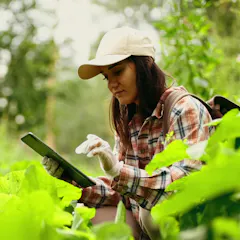
Mathematical concepts could be introduced through calculating the effect of introducing solar panels on the school roof.

A course exemplifies one way group collaboration to address the climate crisis can begin: with each person identifying key moments in their engagement, and contributing this to a larger ‘river’ model.
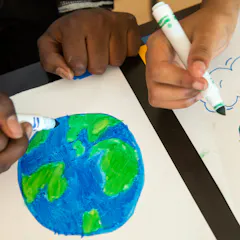
The big, interconnected problem of climate change means teachers need to build lessons beginning with big questions. Five steps for designing classes that draw on interdisciplinary approaches.

Instead of training high school students for an industry that the world is transitioning away from, we need education on energy alternatives and ways of addressing climate change impacts.

Providing teachers with professional development about trauma-sensitive climate change education would help them support students’ experiences of climate change.

Sparking global momentum and energy in young people through climate education can go a long way to addressing climate change now and in the near future.

In a new study, teachers spoke about the difficulties of teaching young people about climate change without adding to their fears.

School systems need to wake up from ‘business as usual’ learning. Teachers can draw on terror management theory in their work on the front lines with students navigating the climate crisis.

‘Eco-champion’ teachers face barriers in implementing climate change education. Communities and school boards can find inspiration to support them from boards with bolder climate commitments.

A comic aimed at high school students looks at the ways people have adapted to climate change in five countries.

More of the curriculum is devoted to climate change, but it’s still not presented holistically. Teachers also need more training and resources to help them prepare students for a changing climate.

Researchers and educators with the Climate Action Childhood network are generating responses to climate change alongside young children.

Children often aren’t aware of how much has been lost in recent generations.
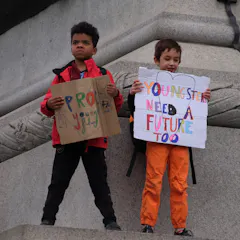
Some children and youth find the effects of climate change are traumatic. Taking a trauma-informed approach to education can nurture resilience.

Peatlands have been central to how northern European folklore has explored fear and a sense of the supernatural for hundreds of years. Their persistence is also key to slowing down climate change.
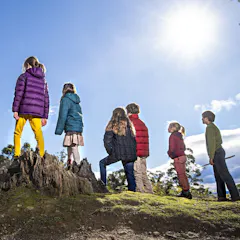
University experts are well placed to equip students with holistic climate knowledge and help teachers cover a subject that’s neglected by the Australian Curriculum.
Picture this change: Through collaborative garden networks, teachers, schools, children, community partners and universities inspire real learning and transformation for a more sustainable world.
Top contributors
-

Lecturer and Research Fellow, School of Geography, Planning, and Spatial Sciences. Coordinator, Education for Sustainability Tasmania, University of Tasmania
-
Senior Lecturer in Curriculum and Pedagogy, University of Tasmania
-
Professor, Institute for Marine and Antarctic Studies and Director of the Centre for Marine Socioecology, UTAS, University of Tasmania
-
Assistant Professor, Educational Leadership and Policy, OISE, University of Toronto
-
PhD Candidate, Doctor of Social Sciences, Royal Roads University
-
Senior Research Fellow in Climate Science Communication, Climate Futures Program, University of Tasmania, University of Tasmania
-
Research affiliate at climate change & (in)security project, Australian National University
-
Research Associate, Journalism, Reuters Institute, University of Oxford
-
Professor of Sustainability, Environment & Education, Southern Cross University
-
Professor in Communication Studies, Concordia University
-
Postdoctoral Research Fellow, Future Ocean and Coastal Infrastructures (FOCI) Consortium, Memorial University, Canada, and Centre for Marine Socioecology, University of Tasmania
-
Postdoctoral research fellow, McGill University
-
Faculty Lecturer, Science Education, McGill University
-
Canada Research Chair of Creativity and STEM and Associate Professor, University of Calgary
-
Assistant Professor, Adult Education, Concordia University