
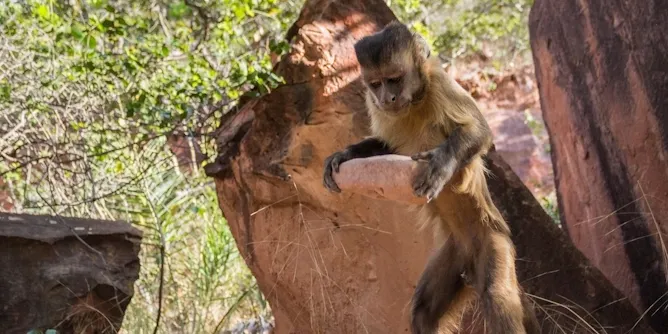
Capuchin monkeys in Brazil use big stones to crush the shells of nuts they want to eat. An experiment in the field investigated how these monkeys prepare to use new, unfamiliar tools.
Articles on Evolutionary biology
Displaying 81 - 100 of 189 articles
A thought experiment from Richard Dawkins’ book The Selfish Gene turned out to be a more realistic explanation for altruism than he expected.
If you go by editorial cartoons and T-shirts, you might have the impression that evolution proceeds as an orderly march toward a preordained finish line. But that’s not right at all.

The mating habits of these tiny, colorful fish may be revealing something broader about the animal kingdom, and perhaps even our own desires.

Hidden forces are always at work in the world, and people always want to control them, a cognitive anthropologist explains. Enter the human universal of shamanism.

Australians report having sex once or twice a week, on average, but there are many variables. And that’s assuming people’s estimates are accurate.
Why are humans the only animals with chins?

Natural selection isn’t the only factor deciding human evolution.
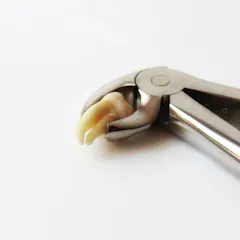
When they cause problems, wisdom teeth don’t seem very smart. But they may have been evolution’s answer to a coarse diet.

Most animal groups adopted their shapes quickly but some kept evolving.
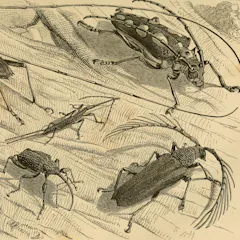
An evolutionary biologist visits the remote jungle mountaintop where a little-known naturalist wrote his insightful paper about the mechanisms of evolution that spurred on a rivalrous Charles Darwin.

Rivers are natural boundaries for evolving populations. But scientists don’t agree whether they create new species or just help maintain them. Research using birds’ molecular clocks provides some answers.

What drives the emergence and disappearance of species? By modeling the fundamental processes of evolution and ecology on geographical scales, new research spotlights topography and climatic shifts.

Vocal deception may have played a key role in our progression from primitive nonverbal noises to complex, controlled speech.

New research on roaring shows that women underestimate their own strength.
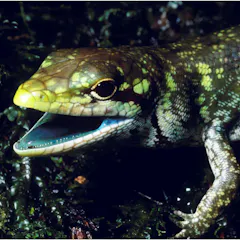
New research shows green-blooded skinks have evolved multiple times, which could help lead to explanation as to why.

Questionable research practices are not fraud, and they’re not cause for panic. But they do give us some hints about how we can make science more robust.
A core idea in molecular biology is that one gene codes for one protein. Now biologists have found an example of a gene that yields two forms of a protein – enabling it to evolve new functionality.
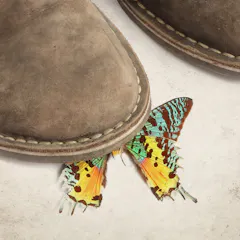
More and more evidence shows evolution isn’t as random as often thought.

Your voice can affect how attractive, fertile and faithful people think you are.
Top contributors
-

Emeritus Strategic Professor in Palaeontology, Flinders University
-
Honorary Associate Professor, UNSW
-
Senior Lecturer, Centre for Behaviour and Evolution, Newcastle University
-
Mark Elgar is a Friend of The Conversation.
Emeritus Professor of Evolutionary and Behavioural Ecology, The University of Melbourne
-
Jenny Graves is a Friend of The Conversation.
Distinguished Professor of Genetics and Vice Chancellor's Fellow, La Trobe University
-
Postdoctoral Researcher , The University of Melbourne
-
Senior lecturer, School of Biological Sciences, University of Bristol, University of Bristol
-
Professor of Avian Behavioural Ecology, Macquarie University
-
PhD Researcher, Nature and Function of Human Nonverbal Vocalisations, University of Sussex
-
Lecturer, Macquarie University
-
Postdoctoral Researcher of Evolutionary Biology, University of Pennsylvania
-
Research fellow, University of Sydney
-
Sexual health researcher, The University of Melbourne
-
Professor of Evolutionary Biology, Université du Québec à Rimouski (UQAR)
-
Associate Professor, School of Psychology, The University of Queensland