
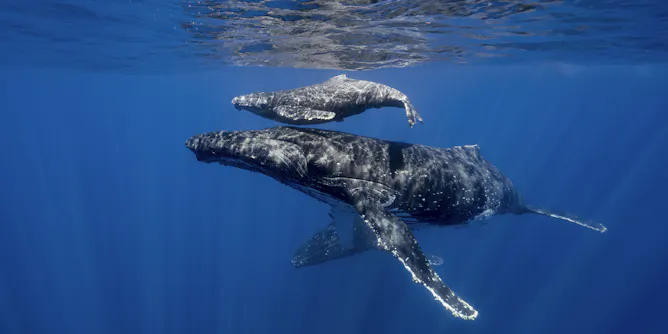
Our latest study takes a closer look at the emotional lives of humpback whales.
Articles on Humpback whales
Displaying 1 - 20 of 22 articles
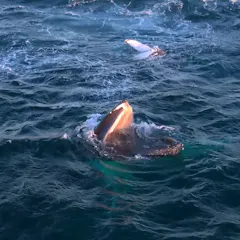
The discovery challenges a long-held assumption about where and when whales feed – and could help us better protect them.
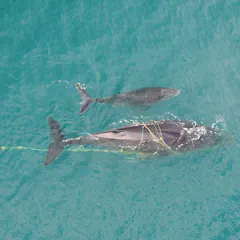
Australian scientists have noticed a rise in the number of whales getting entangled in ropes and fishing lines. Rescuing them is a job for experts.
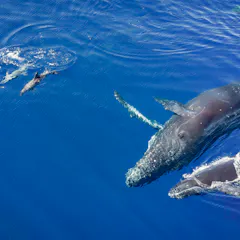
The findings reshape our understanding of how social marine mammals interact across species.
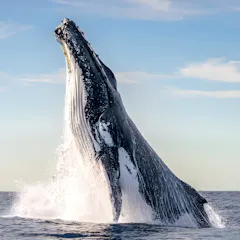
The findings are a window into the rich inner lives of whales – and allow us to check the health of the ocean.
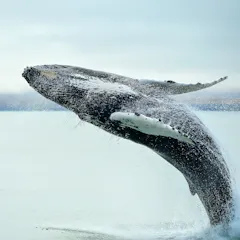
The model tracks the movements of humpback whale mother and calf pods between the Great Barrier Reef and the Gold Coast bay in eastern Australia.
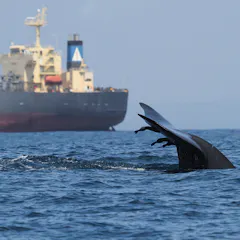
Colliding with ships is a top cause of whale deaths. A new study maps the areas of highest risk, showing where proven strategies such as speed limits and new shipping routes can reduce the toll.
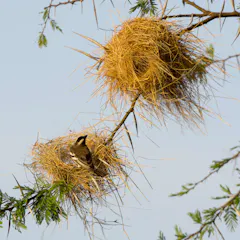
Birds’ building behaviour and the shape of the structures might be the result of social interactions.
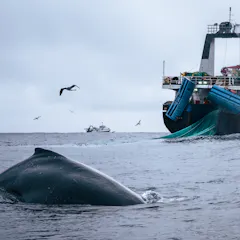
The Southern Ocean’s krill-rich waters attract multiple species of filter-feeding whales – and, increasingly, fishing boats.
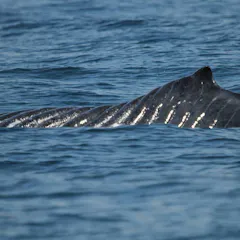
Recent sightings of Bladerunner the humpback and Split Fin the killer whale provide an opportunity to remind everyone to keep their distance and avoid collisions with majestic marine mammals.
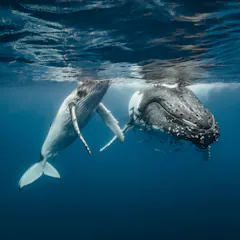
There’s so much we still don’t know about whales. Here’s 3 amazing new things we’ve learnt about whales lately: how humpback whales have sex and give birth – and how baleen whales sing underwater.
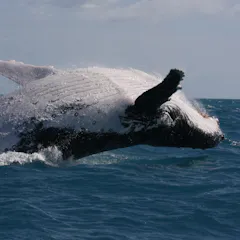
We’ve noticed a clear trend away from singing as a mating tactic among male humpbacks. But it’s probably a pretty good strategy.
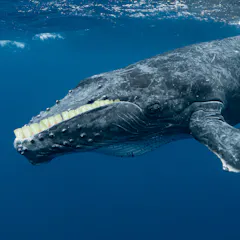
It’s all based on their diet and how they capture their food. But did you know some whales do have teeth?
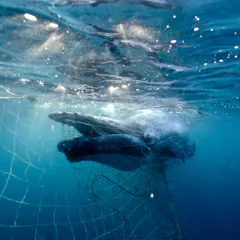
I’ve seen whale entanglement in shark nets firsthand, when a humpback whale calf drowned in one a few years back. It was terrible.
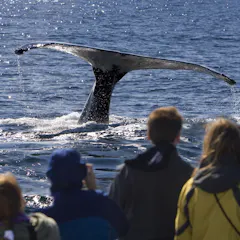
Whether you’re on the shore or a boat, seeing these giant mammals rise from the depths is always special. Knowing how to go about spotting a whale will improve your odds of experiencing this thrill.
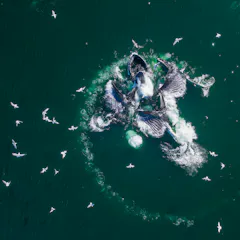
Bubble-net feeding is when whales blow bubbles from their nose to encircle their food, trapping their prey into a tight ball. A citizen scientist was the first to capture this behaviour in Australia.
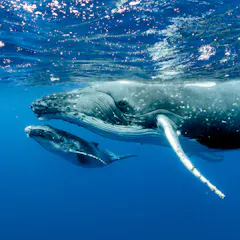
Australia is considering removing humpback whales from the threatened species list after their numbers rebounded in recent decades. But the mammals face new threats.
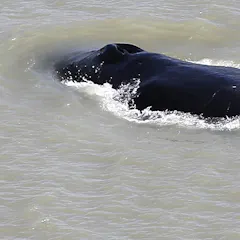
The strange appearance of three humpback whales in a Kakadu river threw up many questions – including whether they’d come out on top in a fight with a crocodile.
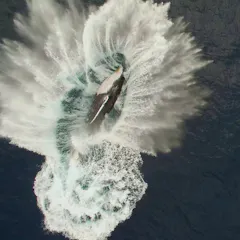
When humpback whales shift their distribution and behaviour, it can lead to unexpected human encounters and new challenges.

Whale breaches and tail slaps look great from a distance. But they can pose a threat if you want to get up close and swim with these giants of the ocean.
Top contributors
-

Whale Scientist and Lecturer, Faculty of Science and Engineering, Macquarie University
-
Research Fellow in Marine Science and Manager Whales & Climate Program, Griffith University
-
Doctoral student | Marine Wildlife Tourism Professional, Auckland University of Technology
-
Senior Lecturer in Physiology, The University of Queensland
-
PhD student , University of Tasmania
-
Professor Emeritus of Tourism, Auckland University of Technology
-
Acting Dean, Health and Environmental Sciences, Auckland University of Technology
-
PhD Candidate, Southern Cross University
-
Research Scientist, Stanford University
-
Lecturer, University of Hull
-
Postdoctoral Researcher in Biology, University of Washington
-
Research Fellow, Coastal and Marine Research Centre, Griffith University
-
PhD Candidate, Marine Ecological Research Centre, Southern Cross University
-
Research Associate, Institute of Marine Sciences and NOAA-NMFS Fisheries Ecology Division, Southwest Fisheries Science Center, University of California, Santa Cruz
-
PhD Candidate, Marine Science, Griffith University