
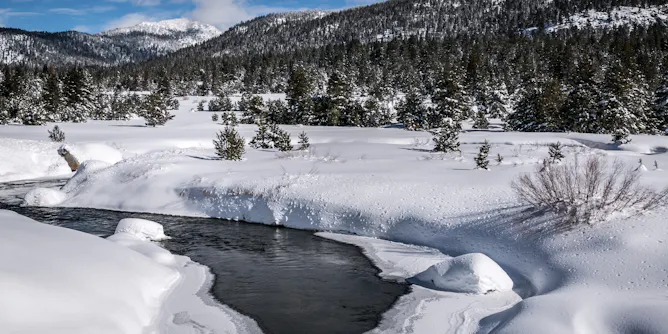
Streamflows the West relies on for drinking water and farms used to follow a fairly predictable arc as winter snow melted. Rising temperatures are changing that.
Articles on Snowpack
Displaying 1 - 20 of 31 articles

Climate change is altering not only how much snow falls, but where snowpack persists and how long it lasts.
A major atmospheric river brought record precipitation to the Pacific Northwest, yet the snow and water supply still suffered. It’s a growing problem.
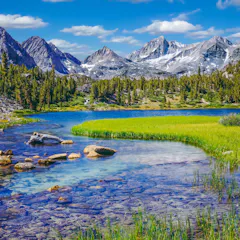
Protecting places that are likely to remain cool and moist as global temperatures rise can save wildlife of all kinds, but first we have to find them.
The 20th anniversary of the annual report tracks how sea ice, snow cover and many other vital signs of the Arctic have changed, and the impact that’s having on people and wildlife.
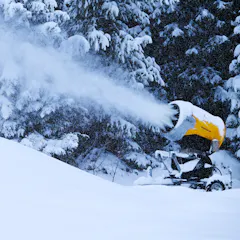
Here’s what snow forecasters are watching, and why skiers and other snow lovers shouldn’t lose hope.
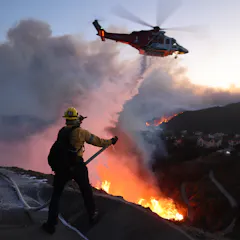
Parts of California are seeing fire season start more than 10 weeks earlier now than in the 1990s.

Tree-rings unlock 195 years of past climate in the Gaspésie mountains.
Snow and ice loss warms the land surface and air, setting off a feedback loop of further ice loss. This destabilises the landscape, with potentially hazardous impacts.
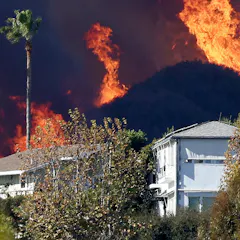
The state is seeing a sharp water divide this year, with lots of rain in the north while the south has stayed dry. A hydrologist explains what’s happening.

These giant rivers in the sky are both destructive and essential for the Western U.S. water supply.
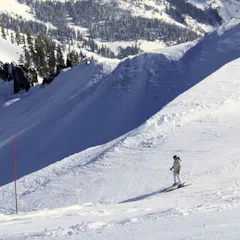
A deadly avalanche at Palisades Tahoe, home of the 1960 Winter Olympics, shows the risk as snow layers melt and new snow falls.
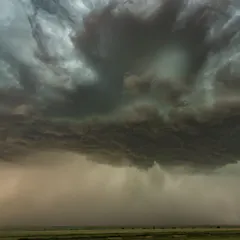
Cloud seeding – spraying materials into clouds to increase precipitation – has been around for nearly 80 years. But only recently have scientists been able to measure how effective it really is.
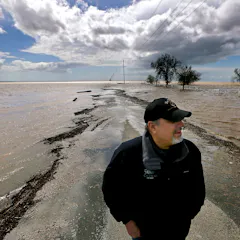
This year’s Sierra snowpack is looking a lot like 1983’s, and that was a year of flooding and mudslide disasters. A meteorologist explains what’s ahead.
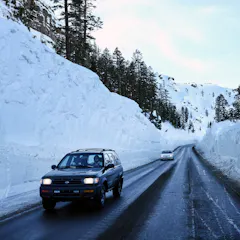
Reservoirs and streams are in good shape in California and the Great Basin, but groundwater and ecosystems are another story. And then there’s the Colorado River Basin.
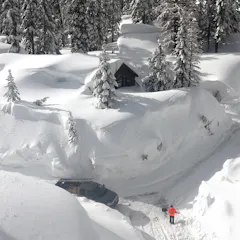
Rain falling on deep snow from a series of atmospheric rivers has heightened California’s flood risk. It’s a growing problem as the planet warms.
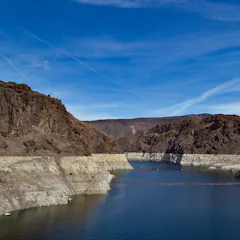
Unprecedented droughts leave the subsurface drier than usual, affecting water supply in subsequent years.
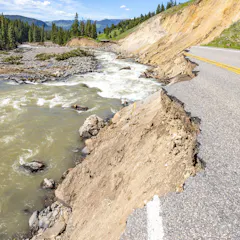
Extreme downpours brought deadly flooding to the Appalachian region, just a few weeks after the destructive Yellowstone River flood.
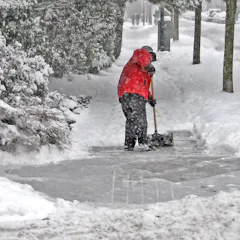
It’s hard to get accurate measurements, but a nationwide network of more than 8,000 volunteers with rulers and specific standards reports after every storm.
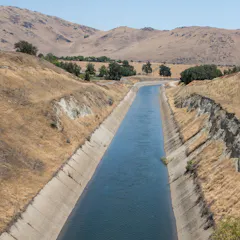
Long before climate change was evident, California began planning a system of canals and reservoirs to carry water from the mountains to drier farms and cities. It’s no longer enough.
Top contributors
-

Assistant Professor of Geology and Geological Engineering, Colorado School of Mines
-
Professor, Director of Ph.D. Program in Biogeoscience, Director of Boston University URBAN Program, Co-Director Boston University Stable Isotope Laboratory, Boston University
-
Researcher of the Atmospheric Composition group, in charge of the WMO Sand and Dust Storm Warning Advisory and Assessment System Regional Center for Northern Africa, Middle East and Europe,, Barcelona Supercomputing Center-Centro Nacional de Supercomputación (BSC-CNS)
-
Assistant Professor, CUNY Graduate Center
-
Adjunct Full Professor of Environmental Conservation, UMass Amherst; U.S. Geological Survey
-
Post-doctoral Research Associate in Paleoclimate, University of Arizona
-
Assistant Professor of Atmospheric Science, University of Wyoming
-
Department of Geography, Assistant Professor, Simon Fraser University
-
Associate Research Professor in Climatology, Desert Research Institute
-
Research and Operations Meteorologist, Center for Western Weather and Water Extremes, University of California, San Diego
-
Project Scientist, University Corporation for Atmospheric Research
-
Adjunct Professor, Department of Renewable Resources, University of Alberta
-
Deputy Lead Scientist, National Snow and Ice Data Center (NSIDC), Cooperative Institute for Research in Environmental Sciences (CIRES), University of Colorado Boulder
-
Senior Scientist, National Snow and Ice Data Center (NSIDC), Cooperative Institute for Research in Environmental Sciences (CIRES), University of Colorado Boulder
-
Associate Professor of Dendrochronology, University of Arizona