
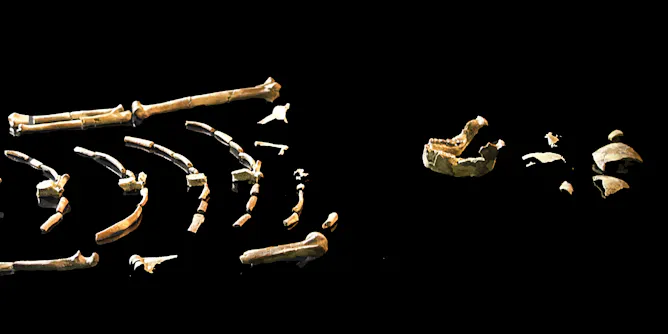
More than any other ancient relative, Lucy has challenged us to think deeply about what it means to be human.
Articles on Human fossils
Displaying all articles

At a global level it is rare to find fossilised hominin tracks.

The exhibit offers a close look at the problematic history of palaeoanthropology.
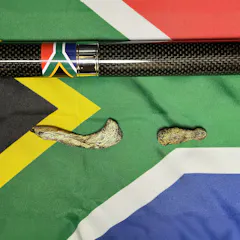
Experts insist there is no scientific reason for allowing these fossils to travel to space.
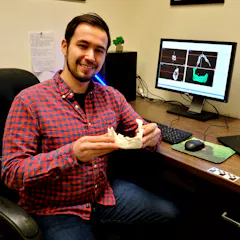
Scientists had figured a fossil found in Spain more than a century ago was from a Neandertal. But a new analysis suggests it could be from a lost lineage of our species, Homo sapiens.

Fossils aren’t just pieces of the past that allow scientists to look backwards. They can play a role in modern policy decision-making, too.
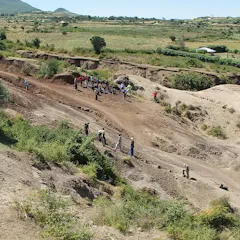
The findings suggest we weren’t the first advanced carnivore among the hominins, as has been previously assumed.
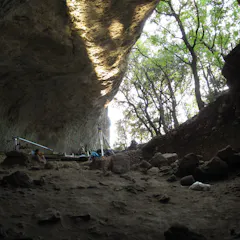
Stone artifacts and a fossil tooth point to Homo sapiens living at Grotte Mandrin 54,000 years ago, at a time when Neanderthals were still living in Europe.

Studying the lower back allows researchers to understand how the species’ anatomy was adapted for different kinds of movement.
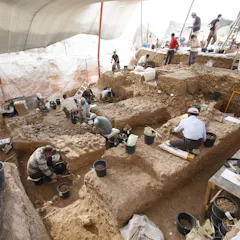
The 140,000-year-old skull fossils are leading to more questions than answers. Also found was the oldest intact campfire ever found in the open air.

Our research has also uncovered major long-term changes in ancient animal populations at Denisova Cave, and has provided the first direct evidence of Homo sapiens having lived there.

Early humans called Denisovans lived in a remote mountain cave between 100,000 and 60,000 years ago, and possibly longer still, raising intriguing questions about their relationship to modern humans.

A new environmental record for a prehistoric site in Kenya helped researchers figure out how external conditions influenced which of our ancient ancestors lived there, with what way of life.
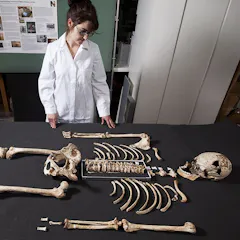
You can’t own a human, so why can you own their remains? We need to stop treating human fossils as objects.

This is a hugely important find. It means that one of our earlier ancestors possibly originated in southern Africa.
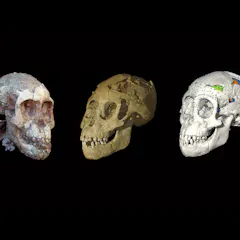
Our findings reveal the slowing down of brain development in our ape-like ancestors began more than three million years ago.
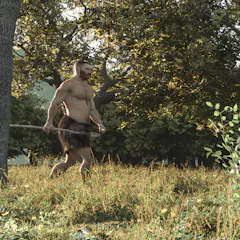
New research suggests humans spread to Europe at least 50,000 years earlier than previously thought.
Top contributors
-

Professor in Geochronology and Geochemistry, Southern Cross University
-
Professor, University of Wollongong
-
PhD Student, Max Planck Institute for Evolutionary Anthropology
-
Director, Palaeo Institute, University of Johannesburg
-
Associate Professor of Biological Anthropology, New York University
-
Senior Lecturer, Faculty of Business, Law and Arts, Southern Cross University
-
Associate Professor, Institute of Tibetan Plateau Research, Chinese Academy of Sciences
-
Director, ARC Centre of Excellence for Australian Biodiversity and Heritage (CABAH), University of Wollongong
-
Professor in the Australian Research Centre for Human Evolution & Griffith Centre for Social and Cultural Research, Griffith University
-
Professor of Archaeological Theory and Method, University of Liverpool
-
Lecturer of Anthropology and Assistant Director of the Turkana Basin Institute, Stony Brook University (The State University of New York)
-
Paleoanthropologist, Université de Bordeaux
-
Group Leader, Max Planck Institute for Evolutionary Anthropology
-
Associate Professor of Archaeology, Griffith University
-
Professor, Institute of Vertebrate Paleontology and Paleoanthropology, Chinese Academy of Sciences