
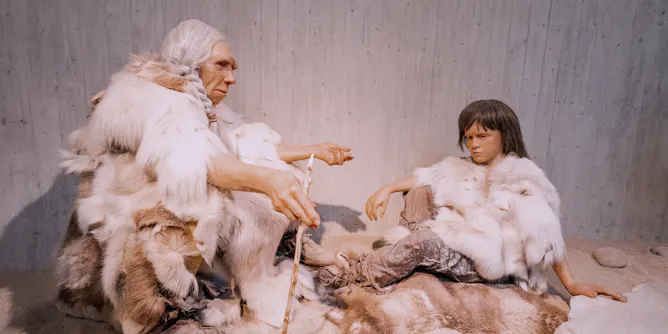
Listen to the The Conversation’s Curious Kids podcast to hear anthropologist April Nowell explain the origins of language.
Articles on Neanderthals
Displaying 1 - 20 of 120 articles
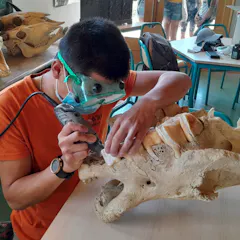
A recent study provides evidence that Neanderthals used rhinoceros teeth as tools.
A recent article published and widely read in Science revealed that Neanderthal men preferred “Sapiens” women, but it fails to tell the whole story.

Tiny triangular-shaped flints from arrowheads found in Uzbekistan shed light on how the first settlement of ‘Homo sapiens’ – our modern human ancestors – came to Europe.

The discovery points to a long evolutionary history in north Africa, much earlier than modern Homo sapiens.
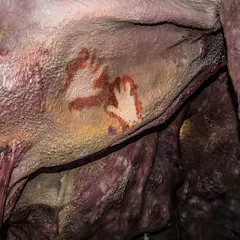
Art has sometimes thought to be exclusive to modern humans.
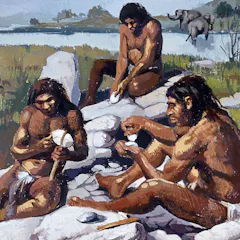
Early nomadic humans living in Europe briefly halted to profit from an unexpected windfall, leaving some important clues about their behaviour.
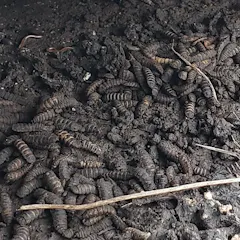
New research highlights the prevalence of maggots as an easily obtained, nutrient-rich supplement of ancient hominin diets.
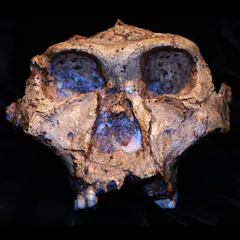
Researchers have extracted 2-million-year-old protein remains from Paranthropus robustus teeth to reveal biological sex and genetic variability.
The balance of different varieties of atoms inside a person’s teeth can reveal a week-by-week record of rainfall and protein consumption during their infancy.

A space physicist has suggested that a reversal of the Earth’s magnetic poles may have wiped out the Neanderthals.
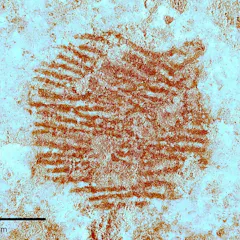
A 42,000 year old stone with a face is the oldest known example of symbolic work by a Neanderthal.
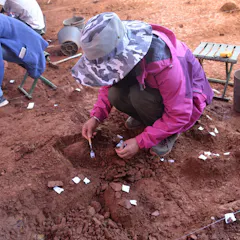
Discovery in China of tools called Quina scrapers suggests the people of East Asia were as inventive and flexible with technology during the Middle Paleolithic era as those in other parts of the world.
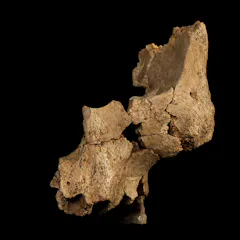
Western Europe appears to have been difficult territory for early human relatives to settle in.
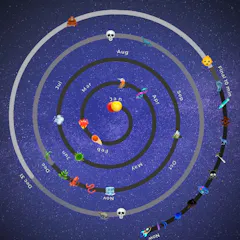
The dinosaurs went extinct on Christmas Day.

The discovery of a finger bone in a cave in Siberia some 15 years ago kicked off a race to unravel the mysteries of an entirely new group of humanoids.

Our understanding of human ancestry has changed dramatically since the discovery of Lucy the ancient hominin 50 years ago. Here is the history of humanity as we know it today.

Named after the writings of J.R.R. Tolkien, Thorin is the first Neanderthal body to be found in France since 1978. He is forcing us to rethink almost everything we knew about early humanity.
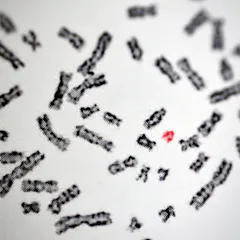
A mysterious century-old law of genetics may explain the puzzling genetic legacy of our extinct Neanderthal cousins.
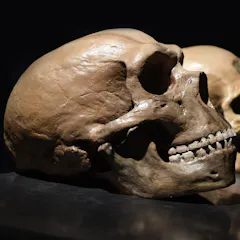
The two human species had many similarities but their communication would have been different.
Top contributors
-

Honorary Associate Professor, UNSW
-
Archéologue et chercheur au CNRS, Auteurs historiques The Conversation France; Université de Toulouse
-
Director, ARC Centre of Excellence for Australian Biodiversity and Heritage (CABAH), University of Wollongong
-
Professor in the Department of Archaeology, Durham University
-
Senior Research Associate in Translational Genomics, University of Oxford
-
Senior Lecturer in Paleontology and Evolutionary Biology, Life Sciences at the University of Bath, University of Bath
-
Emeritus Professor, Department of Archaeology, Classics and History, University of New England
-
Professor in Geochronology and Geochemistry, Southern Cross University
-
Associate Professor of Archaeology, Griffith University
-
Distinguished Professor, Charles Sturt University
-
Professor, University of Wollongong
-
Professor in the Australian Research Centre for Human Evolution & Griffith Centre for Social and Cultural Research, Griffith University
-
Associate Professor in Earth Sciences, University of Adelaide, University of Wollongong
-
Archéologue et chercheuse en anthropologie, Aix-Marseille Université (AMU)
-
Associate Professor of Anthropology, Binghamton University, State University of New York