
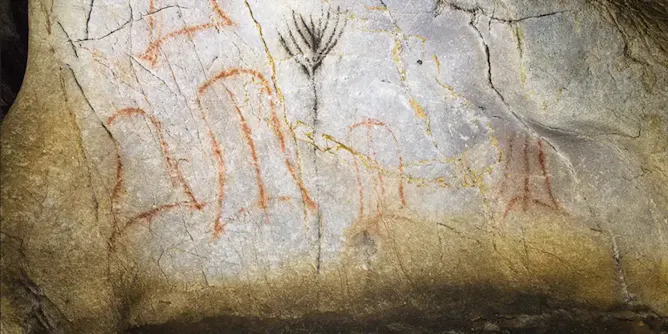
A painted panel deep in a Spanish cave may push the human relationship with mind-altering plants back thousands of years, earlier than anything previously known.
Articles on Paleolithic
Displaying 1 - 20 of 31 articles
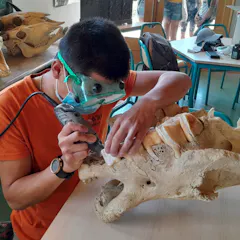
A recent study provides evidence that Neanderthals used rhinoceros teeth as tools.
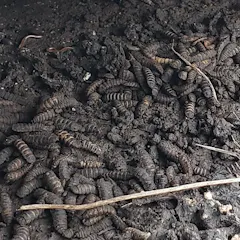
New research highlights the prevalence of maggots as an easily obtained, nutrient-rich supplement of ancient hominin diets.

Out of Darkness attempts at historical accuracy are a welcome surprise, and what’s more, it is fun to watch.
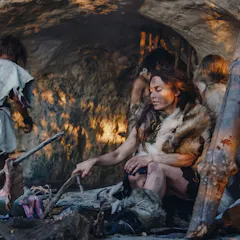
Female bodies have an advantage in endurance ability that means Paleolithic women likely hunted game, not just gathered plants. The story is written in living and ancient human bodies.

Genetic analysis of two skull fragments dating back almost 40,000 years shows that our species colonised Europe from the east and interbred with our Neanderthal cousins.

Meet the archeologist who is overhauling our understanding of early human history.

The Paleo Diet is popular, but research has yet to substantiate its purported health benefits. As evolutionary anthropologists, here’s why we think it’s time to leave the Paleo Diet in the past.

Ancient microbes likely produced natural products their descendants today do not. Tapping into this lost chemical diversity could offer a potential source of new drugs.
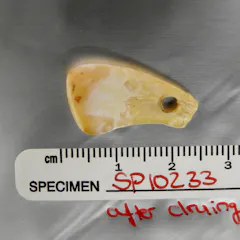
A way to recover the owner’s DNA from ancient artefacts will help archaeologists understand past societies in more detail than ever before.
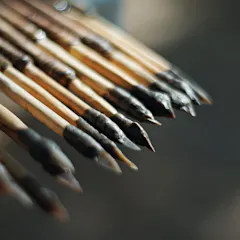
In 2022 we detailed the discovery of 1,500 stone points in France’s Madrin cave. Experiments now show that they could were used as arrowheads, pushing back evidence of archery in Eurasia by 40,000 years.

It’s been 200 years since the discovery of one of the oldest human burial sites in western Europe on the Gower peninsula in south Wales.
New study shows Neanderthals and Homo sapiens had a taste for sharp and bitter food.
When, how, where and why did complex hierarchical societies evolve? Understanding how we got to this point in time may help us address global challenges, like climate change.
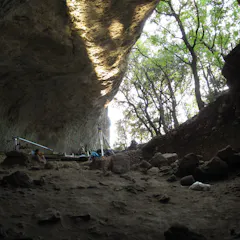
Stone artifacts and a fossil tooth point to Homo sapiens living at Grotte Mandrin 54,000 years ago, at a time when Neanderthals were still living in Europe.

Teens across millennia have yearned to explore, try new things and participate in risky behaviours. The key difference, however, seems to be the experience of a rebellion or restlessness.
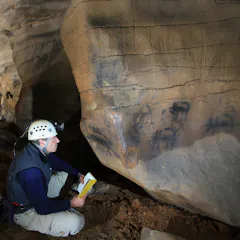
For thousands of years, Native Americans left their artistic mark deep within caves in the American Southeast. It wasn’t until 1980 that these ancient visual expressions were known to archaeologists.

De nouvelles preuves confirment que des différences culturelles intergroupes, notables et anciennes, ont façonné les dernières étapes de l'évolution humaine en Afrique.
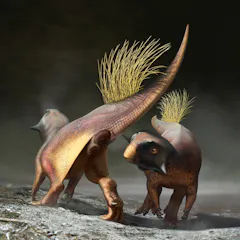
A reconstruction of a dinosaur’s back passage reveals it may have been used for visual communication.
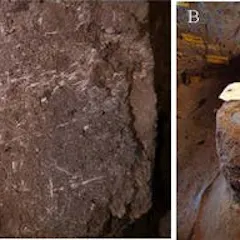
Before 200,000 years ago, close to the origin of our species, people preferred the use of broad-leaved grasses to build their beds and resting areas using ash layers underneath.
Top contributors
-

Archéologue et chercheur au CNRS, Auteurs historiques The Conversation France; Université de Toulouse
-
Archéologue et chercheuse en anthropologie, Aix-Marseille Université (AMU)
-
Lecturer of Anthropology and Assistant Director of the Turkana Basin Institute, Stony Brook University (The State University of New York)
-
Directeur de Recherche CNRS, co-responsable d'équipe de recherche, Institut Jacques Monod, Université Paris Cité
-
Honorary Associate Professor, UNSW
-
Postgraduate Student in Earth and Environmental Sciences, University of Wollongong
-
Professor of Archaeology, University of Washington
-
Project Officer – Office of the Queensland Chief Scientist
-
Paleoanthropologist, Université de Bordeaux
-
Emeritus professor, University of the Witwatersrand
-
Professor in the Department of Archaeology, Durham University
-
Researcher in Scientific Archaeology, University of Liverpool
-
Postdoctoral Fellow in Primate and Human Evolution, Georgia State University
-
Honorary Research Fellow, Cardiff University
-
Professor, Environmental Futures Research Centre, School of Science, University of Wollongong