

The convergence of AI and biotechnology blurs boundaries and challenges existing regulations designed to consider technologies separately.
Articles on Human genome
Displaying 1 - 20 of 56 articles

Researchers are embarking on the RNA equivalent of the Human Genome Project, including sequencing all the chemical modifications that make cells unique.

Studying ancient genes can tell us more about the evolution of humans’ anatomy, behaviour and thinking.

There was previously no direct genetic data from an Egyptian individual of this period.

The promise and peril of sequencing every baby’s genome.

Genetic insights into the Fulani people not only illuminate their biological history but also enrich our understanding of their cultural and historical narratives.

These findings challenge the long-held narrative about migration into and out of North Africa before and during the Neolithic.

Fruit flies have contributed to some of the most important scientific discoveries over the last century. They should be celebrated – not sprayed.

A recent change to South Africa’s national health research guidelines contains newly added language that appears to permit the use of genome editing to create genetically modified children.

Ancient human genomes reconstructed from remains at a southern African rock shelter show remarkable genetic continuity over time.
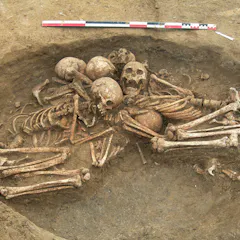
A new study reveals the final stage in the formation of the European genome, which is still present in many people today.

DNA of the male-determining Y chromosome has been completely sequenced end-to-end, and it’s just as weird as we expected. Will we finally be able to understand how it works?

New research sheds light on the interconnected nature of the human genome and what this means for future gene therapies.

New genetic studies claim to be able to foretell our intelligence or predisposition to certain diseases. But two scientists beg to disagree, reminding us that not everything is written in our DNA.

DNA analysis sheds light on important societies within Africa that existed before colonialism.

Beethoven was afflicted with health conditions for much of his adult life, and wished for their cause to be discovered and made public.
At the Third International Summit on Human Genome Editing, experts gather to discuss the path forward for CRISPR and other gene-editing technologies

Following the controversial births of the first gene-edited babies, a major focus of the Third International Summit on Human Genome Editing was responsible use of CRISPR.

DNA analysis reveals a large migration of people into Scandinavia during Viking times.
People don’t randomly select who they have children with. And that means an underlying assumption in research that tries to link particular genes to certain diseases or traits is wrong.
Top contributors
-

Executive Director, Melbourne Genomics Health Alliance
-
Chair, The Conversation Media Group
-
Geneticist and Group Leader, The John Curtin School of Medical Research, Australian National University
-
Distinguished Research Professor, Emerita, Dalhousie University
-
Assistant Professor of Technical & Professional Communication, Michigan Technological University
-
Adjunct Associate Professor, University of Technology Sydney
-
Honorary Fellow, Department of Pathology, The University of Melbourne
-
Professor of Science Communication and Chemistry, University of Hull
-
Postdoctoral fellow in the Division of Molecular Biology and Human Genetics, Department of Biomedical Sciences, Stellenbosch University
-
Head of the Clinical Unit of Medical Genetics and Genetic Counselling, Stellenbosch University
-
Research Professor of Ecosystem Science and Management, Penn State
-
Associate Professor, Psychiatry, UCL
-
Professor of Biological Sciences, Columbia University
-
Professor of Quantum Technologies (Physics and Astronomy), University of Sussex
-
Professor of Anthropology, Deakin University