
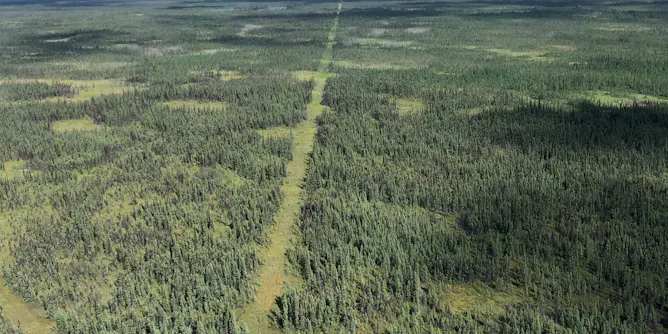
Seismic lines fragment forests and alter their ability to act as habitats and provide climate change mitigation benefits.
Articles on Boreal forest
Displaying 1 - 20 of 45 articles
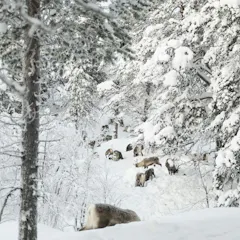
Reindeer herding and forest management can be better integrated to benefit nature restoration, conservation and commercial wood production.

Old-growth forests store 78-89% more carbon than managed forests do.

Maple forests aren’t spreading north as quickly as predicted.
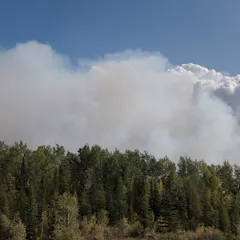
As global temperatures rise, wildfires are advancing further north. Many of them burn through peat, which contains massive amounts of carbon.
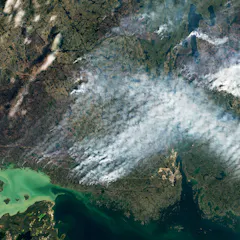
Global carbon emissions from forest fires have increased by 60% over the past two decades, with the largest contributions coming from fires in Siberia and western North America.

The leaves of evergreen species acquire carbon over the long term and improve nutrient conservation, whereas short-lived leaves favour rapid carbon acquisition.

Carbon lost during the 2018 fire season in Sweden could take 40 years to return to trees and soil.

Research suggests these forests could disappear by the 2070s.
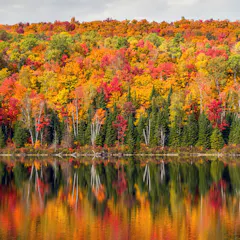
Research shows that the distribution of temperate hardwoods (sugar maple, red maple and yellow birch) could be shifting northward, which would have serious consequences for the boreal forest.
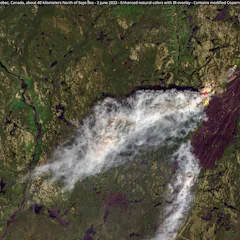
The forest fires of the summer of 2023 in Québec were devastating. It was the worst year in 50 years. But with climate change, the worst may be yet to come.
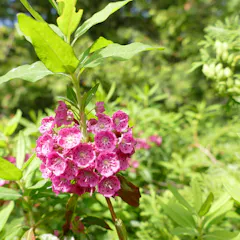
Boreal plants produce molecules that are valued by traditional medicines and inspire the development of medicinal products by contemporary chemists.
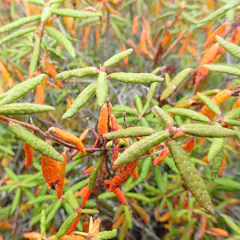
Some boreal plant species are classified — and treated — as weeds, affecting Indigenous communities’ access to important cultural, medicinal and ceremonial resources.
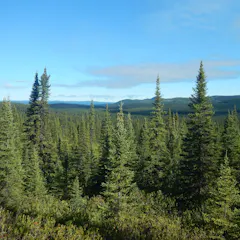
New scientific discoveries are being made by drawing on Indigenous peoples’ ancestral knowledge about medicinal plants.

A realistic look at forest management on the Nitassinan of Pessamit, based on data from the Québec government’s forest inventories.
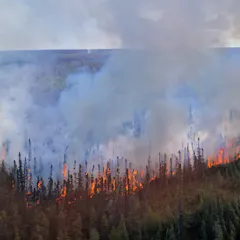
Zombie fires smoulder through the winter and reignite in the early spring. How these fires behave is not well understood, but they can contribute to an earlier and longer fire season.

Can planting trees help us solve the climate crisis? Probably, but to what extent?
Is it possible to measure sustainable development? Can we go beyond merely embracing virtuous principles and put the concept into use?

Beavers are an important ecosystem engineer in the boreal forest and researchers are demystifying their secrets.
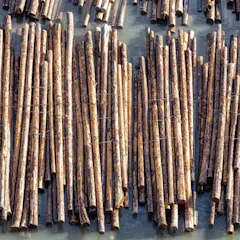
Logging over the past two centuries has had a major impact on Québec’s forests. The traces it has left will guide the adoption of sustainable forest management techniques.
Top contributors
-

Agente de transfert de connaissances pour le Centre de recherche sur la boréalie (CREB), Université du Québec à Chicoutimi (UQAC)
-
Professor of Geography and Director of the Centre for Wildfire Research, Swansea University
-
Professeur-chercheur en biochimie et pharmacologie, Université du Québec à Chicoutimi (UQAC)
-
Professeur titulaire Chaire en éco-conseil spécialiste des changements climatiques, Université du Québec à Chicoutimi (UQAC)
-
Professeur d'écologie forestière, Université du Québec en Abitibi-Témiscamingue (UQAT)
-
Adjunct professor, Carbone boréal, Université du Québec à Chicoutimi (UQAC)
-
Assistant Research Professor, Northern Arizona University
-
Fellow, Queen's Institute for Energy and Environmental Policy, School of Policy Studies, Queen's University, Ontario
-
Adjunct Professor of Biology, University of Saskatchewan
-
Professeur-chercheur en écologie forestière, Université du Québec à Chicoutimi (UQAC)
-
Professor - Industrial ecology and climate change mitigation, Université du Québec à Chicoutimi (UQAC)
-
Professor and Canada Research Chair in Forests and Global Change, Wilfrid Laurier University
-
Professeur écologie et aménagement forestier, Université du Québec en Abitibi-Témiscamingue (UQAT)
-
Professeur en chimie des produits naturels, Université du Québec à Chicoutimi (UQAC)
-
Associate Professor, Department of Physical Geography and Ecosystem Science, Lund University