

It might appear featureless, but one of the world’s largest limestone regions hides a remarkable underground world.
Articles on Caves
Displaying 1 - 20 of 40 articles
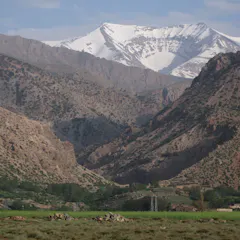
Africa has some of the world’s most important geological landscapes, yet they remain under-represented in digital geoheritage research.
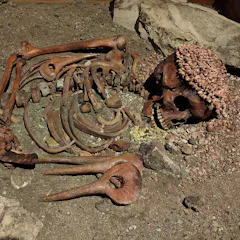
Prehistoric humans were emotionally and socially sophisticated in how they handled death, and the archaelogical evidence at Arene Candide proves it.
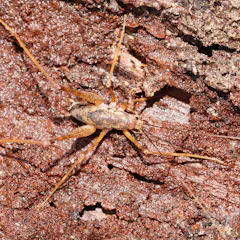
Caves have long been a refuge. But climate change could pose an existential threat to cave crickets and other cave dwellers.

More than a hundred years after it was found in Foul Air Cave in Victoria, the fossil is granting us new insights into deep time.

Thousands of years ago, adults and children left their marks on soft rock surfaces deep in this cave in GunaiKurnai Country.
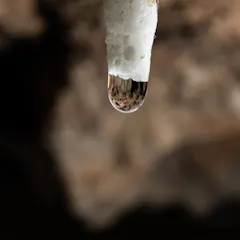
Groundwater sustains life, from farming to wild animals. But we don’t fully know how quickly it recharges.
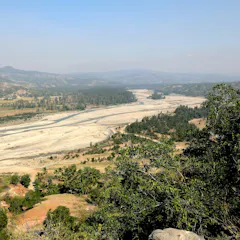
New evidence from Laili rockshelter on Timor hints at a rapid, large-scale human arrival 44,000 years ago.
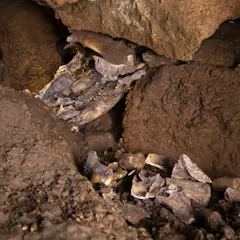
Finding and retrieving the bones of this extinct kangaroo relative – a ‘holy grail’ fossil – took hours of squeezing through narrow passages.
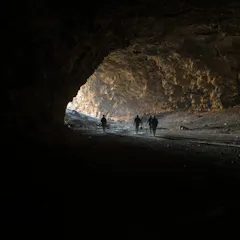
New research reveals signs of ancient human habitation in a vast cave beneath the Arabian desert. It may have been used as a waystation by Stone Age herders travelling from one oasis to another.
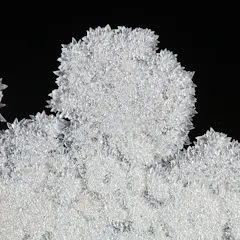
Despite cold temperatures, water was relatively abundant in much of the southern hemisphere during ice ages.
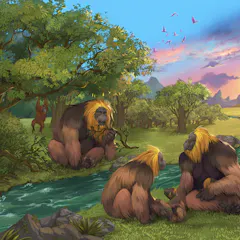
What happened to the three-metre tall apes that once lived alongside orangutans? A new study suggests they were too slow to adapt to a changing world.
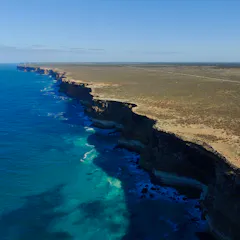
Most of us see only the dry treeless plain and spectacular sea cliffs. But beneath the surface there’s a precious world of caves and unique species that could be lost without better protection.
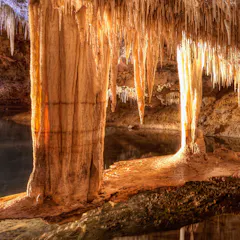
South-west Australia relies on groundwater for three-quarters of its water use. But a new study of the region’s caves has found a drying climate is having a dramatic impact on this precious resource.

One person recently spent 100 days underwater. Another lived 500 days in a cave. What can we learn from such extreme experiences?
Beatriz Flamini may have set a new record for longest voluntary isolation.

The caves now serve as important safe spaces in an area designated ‘Firing Zone 918’ by Israel, as residents describe a growing wave of forced evictions and building demolitions.
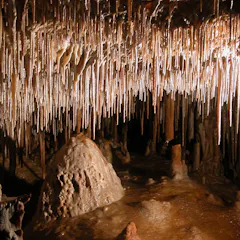
The findings will help us better understand how biodiversity responds to a changing climate over time.

As water dripped in a remote cave, it left behind evidence of every monsoon season for a millennium. Scientists say it holds a warning for a country about to become the most populous on Earth.
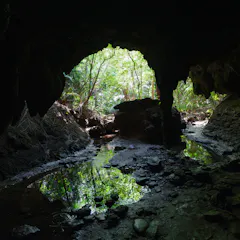
Caves form over millions of years, as a result of flowing water slowly working away at ‘soft’ calcareous rock.
Top contributors
-

Professor, School of Biological, Earth and Environmental Sciences, UNSW
-
Senior Lecturer, School of Biological Sciences, Adelaide University
-
Collection Manager, Vertebrate Palaeontology, Museums Victoria Research Institute
-
Research Scientist, Environment Business Unit, CSIRO
-
Postdoctoral researcher in Geochemistry/Palaeoclimatology, University of California, Berkeley
-
Honorary Research Fellow, The University of Melbourne
-
Lecturer in Hydrogeology, School of Environmental and Life Sciences, University of Newcastle
-
Associate Professor and Director, Flinders Microarchaeology Laboratory, Flinders University
-
Professor emeritus, The University of Melbourne
-
Associate Professor of Osteoarchaeology, Uppsala University
-
Professor of Archaeological Theory and Method, University of Liverpool
-
Associate Professor, Connected Waters Initiative, UNSW
-
Associate professor, UNSW
-
Professor Emeritus in Geophysics, Keele University
-
Postdoctoral Fellow of Archaeology, University of Southampton