
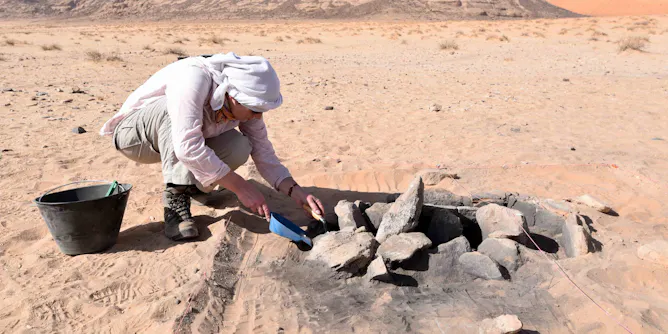
A close look at 7,000-year-old grinding stones left in ancient firepits shows wandering herders in northern Saudi Arabia carried heavy tools for working on bones, plants and rocks.
Articles on Stone tools
Displaying 21 - 40 of 51 articles
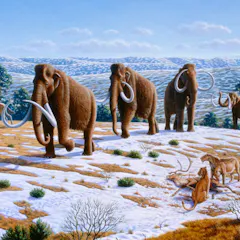
A forensic technique more often used at modern crime scenes identified blood residue from large extinct animals on spearpoints and stone tools used by people who lived in the Carolinas millennia ago.
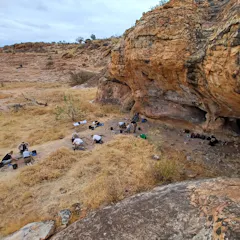
Hunter-gatherers were an important part of the development of the Mapungubwe Kingdom in southern Africa – a fact that history has tended to neglect.
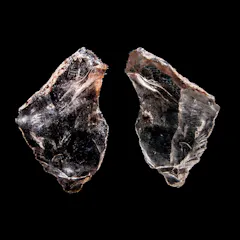
Shared designs for stone tools across southern Africa show early humans had wide social connections before beginning to migrate to the rest of the world.
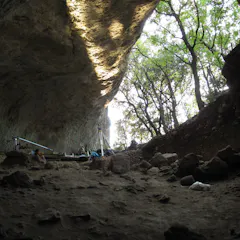
Stone artifacts and a fossil tooth point to Homo sapiens living at Grotte Mandrin 54,000 years ago, at a time when Neanderthals were still living in Europe.
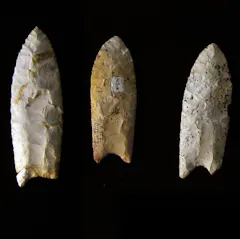
The stone age saw a pattern where technologies like spears, fire and bows were invented once, then spread
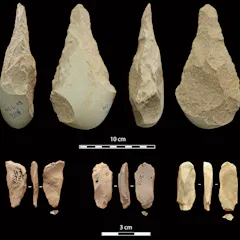
Knowing that our North African ancestors were making handaxes helps scientists to understand how our human ancestors spread across the African continent.
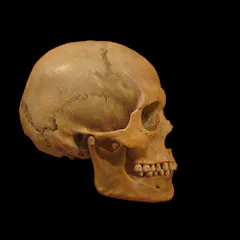
What looks like a bright, sharp dividing line between humans and other animals is really an artefact of extinction.

The Su-re site has provided a historical connection between local Tibetans in the highlands with Nepali Sherpas in the Himalayan lowlands.

Combining evidence from archaeology, geochronology and paleoenvironmental science, researchers identified how ancient humans by Lake Malawi were the first to substantially modify their environment.

Plus, new discoveries about early humans in Tanzania’s Olduvai Gorge. Listen to episode 5 of The Conversation Weekly podcast.

A new environmental record for a prehistoric site in Kenya helped researchers figure out how external conditions influenced which of our ancient ancestors lived there, with what way of life.

Archaeological discoveries in a jungle cave in central Indonesia suggest humans arrived there 18,000 years ago and decided to stay a while, hunting in the jungle and building canoes.
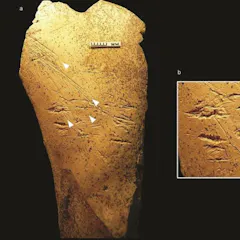
The Boxgrove people, like all other human species, were capable of sharing time, care and knowledge in all parts of their life.
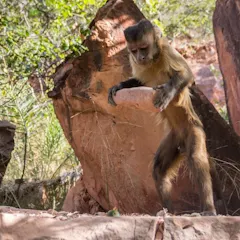
Capuchin monkeys in Brazil use big stones to crush the shells of nuts they want to eat. An experiment in the field investigated how these monkeys prepare to use new, unfamiliar tools.
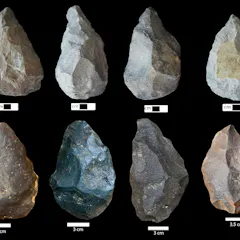
There’s almost no place on earth that doesn’t hold traces of humanity. But which routes did our ancestors follow first?

Ancient stone tools found in what is now Algeria show early humans likely spread across Africa more rapidly than first thought.
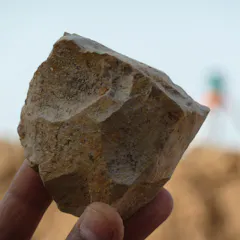
New discovery could be a game changer for archaeology.
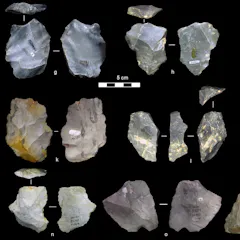
A fresh look at museum artifacts fills in a gap in the Asian archaeological record and refutes the idea that an advanced technique was imported from the West by early modern humans.

They were looking to study rock art at a remote desert site but what they found showed people had been using the place almost since the first people arrived in Australia.
Top contributors
-

Director, ARC Centre of Excellence for Transforming Human Origins Research, Griffith University
-
Professor of Archaeology, University of Washington
-
Principal Research Associate, UCL
-
Senior Lecturer in Paleontology and Evolutionary Biology, Life Sciences at the University of Bath, University of Bath
-
Senior Lecturer, University of Mpumalanga
-
Assistant Professor of Anthropology, Yale University
-
Adjunct Senior Researcher at Griffith University and La Trobe University, and Ramón y Cajal (Senior) Research Fellow, Centro Nacional de Investigación sobre la Evolución Humana (CENIEH)
-
Lecturer of Anthropology and Assistant Director of the Turkana Basin Institute, Stony Brook University (The State University of New York)
-
Laureate Professor in Archaeology, The University of Western Australia
-
Senior Lecturer in Palaeolithic Archaeology, University of Southampton
-
Archéologue et chercheur au CNRS, Auteurs historiques The Conversation France; Université de Toulouse
-
Curator at the Origins Centre Museum, University of the Witwatersrand
-
Professor, School of Humanities, Languages and Social Science, Griffith University
-
Postgraduate Student in Earth and Environmental Sciences, University of Wollongong
-
Postdoctoral Research Fellow, The Stone Age Institute and The Center for Research into the Anthropological Foundations of Technology, Indiana University