
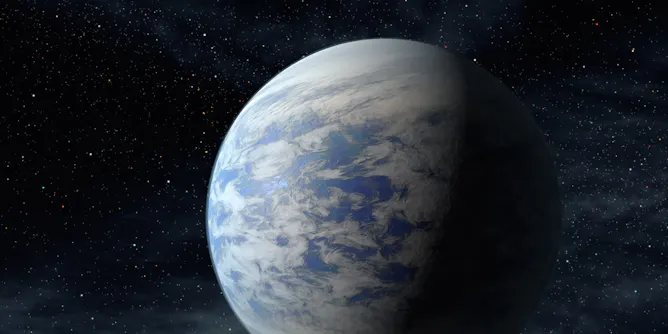
Newly discovered super-Earths add to the list of planets around other stars that offer the best chance of finding life. An astronomer explains what makes these super-Earths such excellent candidates.
Articles on Astronomy
Displaying 361 - 380 of 1002 articles
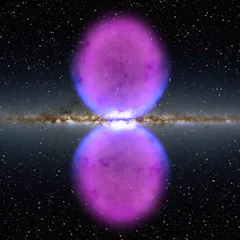
A glowing blob in the sky known as “the cocoon” may be caused by pulsars in the Sagittarius dwarf galaxy.
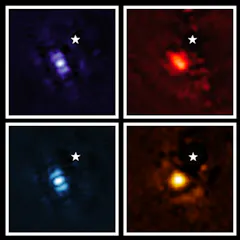
The James Webb Space Telescope just released its first-ever exoplanet image. Here’s what’s so exciting about it, and what we can stand to learn.
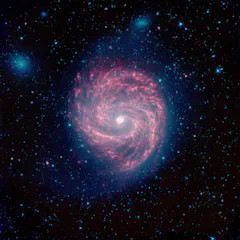
A comparison of star-forming galaxies suggests, surprisingly, that dark matter and visible matter do interact – taking us closer to understanding what keeps the galaxies together.
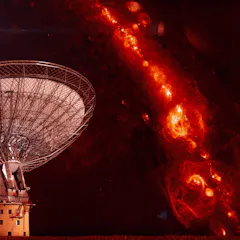
Listening for events like black hole collisions is important in astronomy research – and the technology is only getting better.
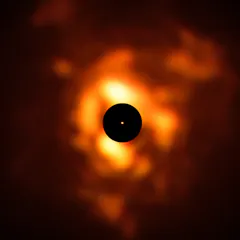
Humanity has a front-row ticket to astronomical history in the making – the death of Betelgeuse.
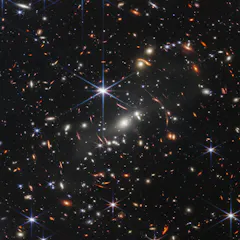
James Webb has spotted extremely distant galaxies formed soon after the Big Bang, but are they old or young? Or is this the wrong question to ask?
Earth is moving through a bit of space where three streams of debris intersect with our orbit. These streams will give birth to the stars of this weekend’s show.
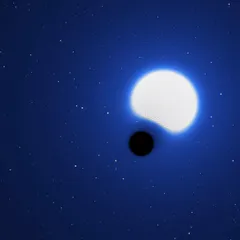
Astronomers have discovered the first dormant black hole outside of the Milky Way. These black holes are not absorbing matter from a nearby star, making them incredibly hard to find.
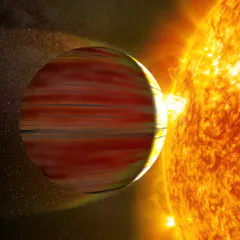
The unusual planetary system has a host star orbited by two giants. One has an incredible odd route around its star. And the other (unlike our own gas giants) is hellishly hot.
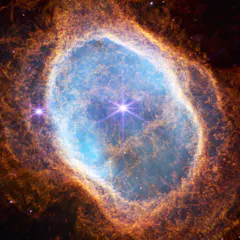
Why is the universe 13.8 billion years old, but 93 billion light-years across? It’s all about how light travels through the cosmos.
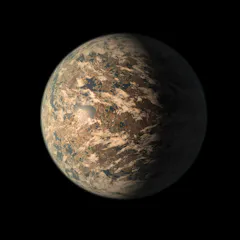
Life on Earth has dramatically changed the chemistry of the planet. Astronomers will measure light that bounces off distant planets to look for similar clues that they host life.
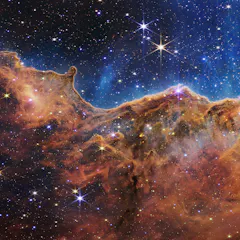
Long before the James Webb telescope brought us these deep field images, artists have been capturing notions of space.

Through direct comparison with images from Hubble, you can start to see the exquisite detail and clarity Webb provides.
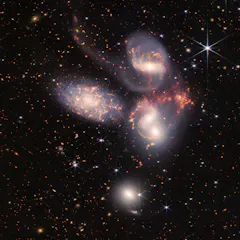
NASA released five new images from the James Webb Space Telescope, revealing incredible details of ancient galaxies, stars and the presence of water in the atmosphere of a distant planet.

Even experts were not prepared for the crispness of the new images from the James Webb space telescope.
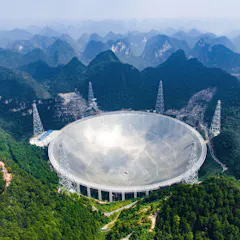
Have astronomers finally found evidence of intelligent found life beyond Earth?
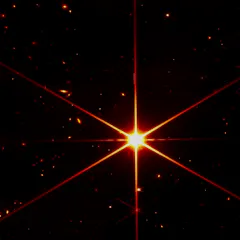
It has taken eight months to test and calibrate all of the instruments and modes of the James Webb Space Telescope. A scientist on the team explains what it took to get Webb up and running.
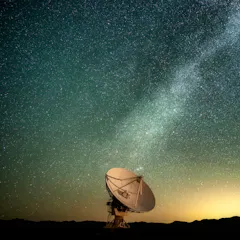
Astronomers studying fast radio bursts recently discovered one that repeats, has a persistent radio signal and originated in a galaxy much closer than it should have.
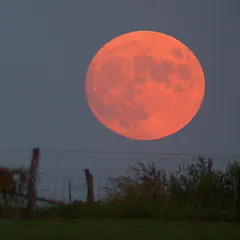
The Moon illusion is what makes the Moon look giant when you see it rising over a distant horizon. An astronomer explains what causes this awe-inspiring trick of the mind.
Top contributors
-

Professor (Astrophysics), University of Southern Queensland
-
Senior Curator (Astronomy), Museums Victoria Research Institute; The University of Melbourne
-
Associate Professor in Astronomy, Monash University
-
University Distinguished Professor of Astronomy, University of Arizona
-
Associate Professor, School of Physics, The University of Melbourne
-
Professor of Astrophysics, University of Sydney
-
Professor, Radio Astronomy, University of Sydney
-
Honorary Fellow, Space and Astronomy, CSIRO; Western Sydney University
-
John Curtin Distinguished Professor (Radio Astronomy), Curtin University
-
Pro Vice-Chancellor Flagship Initiatives, Swinburne University of Technology
-
Postdoctoral Researcher in Radio Astronomy, University of Sydney
-
Senior Lecturer in Physics, Nottingham Trent University
-
Associate Dean of Innovation and Engagement, Swinburne University of Technology
-
Lecturer in Astronomy, Nottingham Trent University
-
Dean of Science, University of California, Santa Cruz