
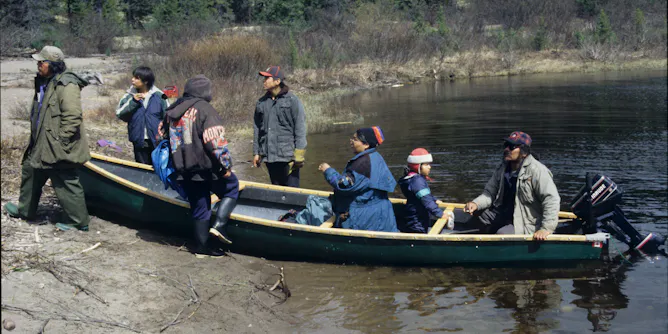
The emergence of a well-resourced rival claim to Indigenous land rights is of growing concern to the Innu people of Labrador-Quebec.
Articles on Indigenous
Displaying 121 - 140 of 769 articles
There is ample evidence showing Indigenous Peoples and their territories are essential to the world’s biodiversity. We don’t need an unsupported statistic to prove it.

A course exemplifies one way group collaboration to address the climate crisis can begin: with each person identifying key moments in their engagement, and contributing this to a larger ‘river’ model.

Harry Mosby won a silver medal for Australia at the 1976 Paralympics. It has only recently come to light how significant that achievement was.
Four Red River Métis scholars discuss their intimate role in the ongoing issue of Indigenous identity fraud.

The B.C. Court’s dismissal of Chief Dsta’hyl’s justification that he was following Wet’suwet’en law points to the need for broader discussion regarding rights and jurisdiction.
Now more than ever we need Red River Métis health data that is conducted ethically and is respectful of both individual and collective rights, and accurately represents our distinct population.
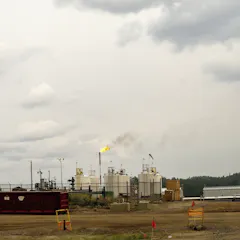
The dispute between the Blueberry River First Nations and the government of B.C. reveals deeper issues with imposed Indigenous governance systems.
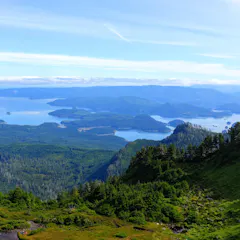
The agreement between the Haida Nation and B.C. is laudable. However, Canada’s history of false promises means the federal government is unlikely to enact similar deals any time soon.
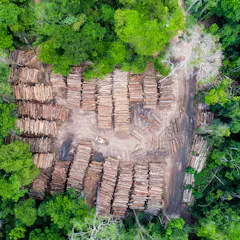
To reduce deforestation and boost biodiversity to help address climate change, returning lands to Indigenous communities is crucial and effective.
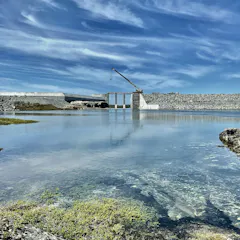
The energy transition requires the development of new infrastructure, which can have adverse effects on the environment and on certain communities.

Although there is now a wide body of public information about residential schools, many people continue to have limited knowledge about them. That provides fertile ground for misinformation.

A website curated by Indigenous historians shares reading lists about Indigenous histories in Turtle Island (North America) related to over 40 topics, as well as a podcast offering oral histories.
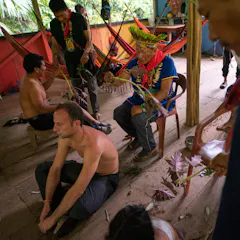
The psychotropic allure of the ayahuasca plant for hundreds of thousands of non-Indigenous consciousness seekers is raising many concerns.
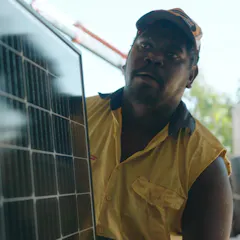
Our new report makes 12 recommendations for how industry, government, educators and First Nations communities can create jobs and fulfilling careers in clean energy.
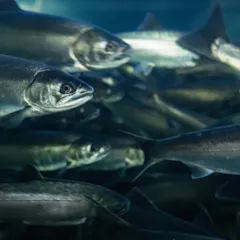
Indigenous knowledge is a boon to environmentally responsible efforts, but only if the data — and its holders — are treated with respect.
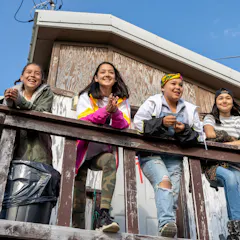
The Winnipeg-based series has screened over 100 films in multiple genres by Indigenous filmmakers, and brings filmmakers together with audiences as a form of public education.

Limiting who public space is for and how it can be used is central to settler colonialism both in Canada and other settler colonial places. Here’s how it’s used to silence and criminalize dissent.

All canoe trips pass through the territories of Indigenous Peoples who are rightsholders to those lands. How can canoers work to account and reconcile for colonialism in Canada?
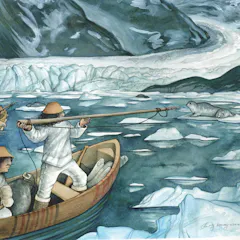
Collaborative research by archaeologists, environmental scientists and tribal elders combines science and Indigenous knowledge to tell the story of centuries of life at a glacier’s edge.
Top contributors
-

Professor of Law, University of Technology Sydney
-
Professorial Fellow, University of Canberra
-
Professor, Faculty of Education, University of Manitoba
-
Professor of Political Science, University of Guelph
-
Associate Professor, Departments of History and Indigenous Studies, University of Manitoba
-
Assistant Professor, Indigenous Methodologies, Chanie Wenjack School of Indigenous Studies, Trent University
-
Professor of Economics and Public Policy, ANU College of Arts and Social Sciences, Australian National University
-
Associate professor, McGill University
-
Executive Co-Director, UNU Hub on Empowering Communities to Adapt to Environmental Change, Institute for Water, Environment and Health, United Nations University; University of Calgary
-
Professor, Critical Indigenous Studies and Director of The Centre for Global Indigenous Futures, Macquarie University
-
Associate Professor, UNSW
-
Professorial Fellow, Jumbunna IHL, University of Technology Sydney
-
Associate Professor, Faculty of Law & Justice, UNSW
-
Associate Professor of Gender, Religion and Critical Studies, University of Regina
-
Associate Professor of Public Policy, Crawford School of Public Policy, Australian National University