
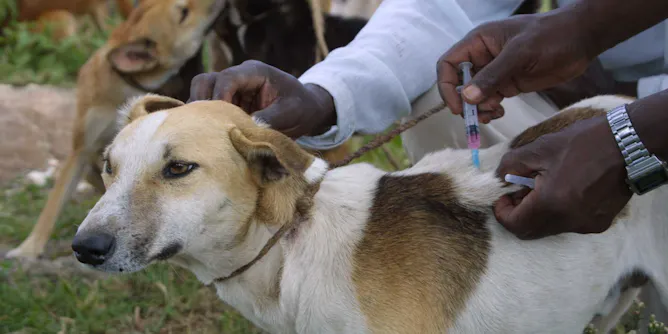
Domestic dogs have been shown to be the only species necessary to maintain rabies across most of Africa. This means that dog vaccination should control the disease in all species.
Articles on Tanzania
Displaying 141 - 160 of 356 articles
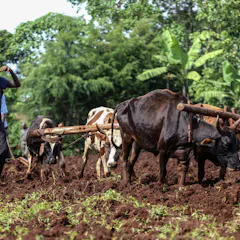
Research questions the idea that getting commercial seeds and fertilisers to smallholder farmers will double yields and incomes.
Small and medium-scale farmers and agri-businesses in Southern and Eastern Africa, which are at the heart of inclusive food value chains, are not receiving fair prices for their produce.
Countries must be encouraged to distribute essential healthcare provision - like diagnosis - to where people most need them and where they can be accessed more easily.

CC BY-NC-ND6.95 MB (download)
The deaths have important symbolic value and have been associated with shifts in COVID-19 policies in some countries.

Finding a way to increase the participation of men and fathers in unpaid care work would have an important influence on a more equal distribution between women and men.
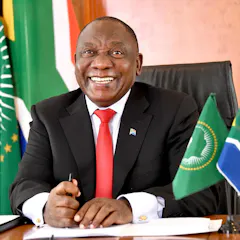
An effective regional approach to combating COVID-19 has seen Africa avoid the worst so far.
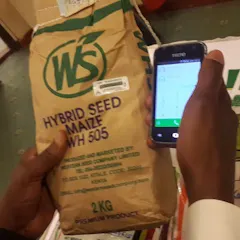
Countries have adopted a wide array of measures involving a proliferation of fraud agencies.

Maasai in Tanzania use their mobile phones all the time – usually to communicate with people they already know. But dialing errors can also breed friendships and business opportunities.

The Malawi court’s decision provides a roadmap for future challenges to the death penalty in other southern African countries.

Because of their appearance, people with albinism in Tanzania are often socially excluded and frequently (and sometimes violently) discriminated against.
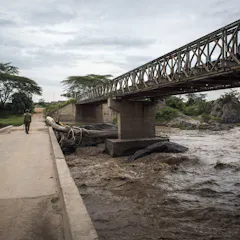
Governments must ensure that transport infrastructure is developed with the ability to cope with current and future climatic shifts.
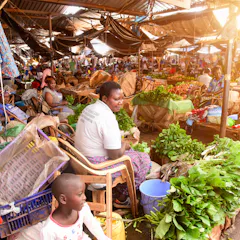
When it comes to food safety solutions, models which enforce bans and regulations don’t fit.
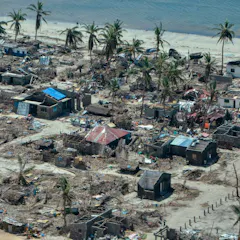
Land-falling tropical cyclones are rare in Tanzania so past events are outside the memory of most.

National sports victories increase nationalism and national pride, but can also influence attitudes towards refugees.
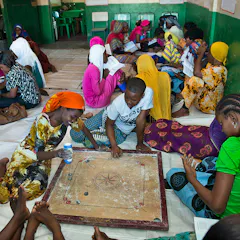
This research provides fresh insights into strategies that can be used to improve the lives of adolescents in sub-Saharan Africa and around the world.
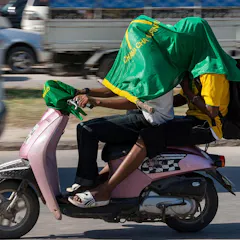
There may be significant limitations to the political reform that can be realised by new president Samia Suluhu Hassan.

Without reliable, local and timely data, countries will miss the potential of sugar-sweetened beverage taxation as a public health intervention.
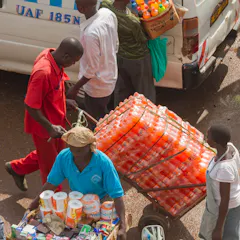
Implementing a sugar-sweetened beverage tax in all African countries will require sufficient political will and support from civil society.

She has been described as compassionate, rational and calm – attributes that are a far departure from her former boss.
Top contributors
-

Researcher, United States International University
-
Lecturer, Tumaini University Makumira
-
Assistant professor, University of Sussex
-
Post-Doctoral Research Fellow, SARChI in Higher Education and Human Development Research Group, University of the Free State
-
PhD Candidate, Department of Political Science and Public Administration, University of Nairobi
-
Senior Lecturer in Politics and International Relations, University of East London
-
Professor of Democracy, University of Birmingham
-
Research Associate Plant Systematics, Bayreuth University
-
Associate Professor of International Studies, University of Nottingham
-
Lecturer in Wildlife Conservation
-
Professor of French and Critical Disability Studies, Lancaster University
-
Asso. Professor in Anthropology, University College London, UCL
-
Professor of Disease Ecology and Public Health, University of Glasgow
-
Senior Lecturer in Social Work, Australian Catholic University
-
Researcher, SAMRC/Centre for Health Economics and Decision Science- PRICELESS SA, University of the Witwatersrand