
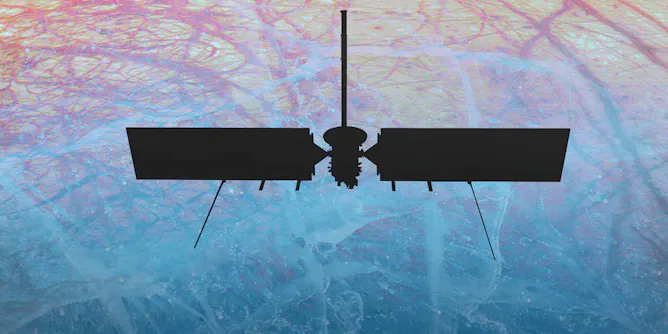
Europa Clipper will contain a plaque that celebrates humanity’s relationship with water and a decades-old tradition of searching for life outside Earth.
Articles on Astronomy
Displaying 221 - 240 of 1002 articles
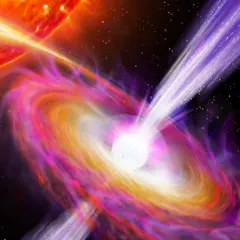
Powerful jets are launched from the most massive objects in our universe, but we don’t fully understand how. This measurement gets us a step closer to solving the mystery.
The solar corona can be seen during the solar eclipse on April 8. Astronomers are still trying to figure out the mysteries of the corona, including why it’s so hot.
The eclipse will allow scientists to get rare measurements of the Sun’s atmosphere.
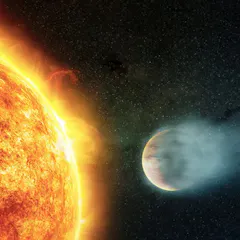
There are several ways in which stars can destroy and swallow their own planets.

Eclipses are rare, fantastic celestial events. Here’s how educators can help visually impaired students enjoy eclipses alongside their sighted peers.

The largest study yet of ‘twin stars’ shows planetary orbits may be less stable than we thought.
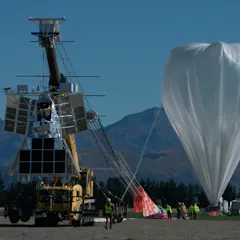
Giant helium balloons are a cheap, more environmentally friendly alternative to rocket launches – and you get the satellite back.
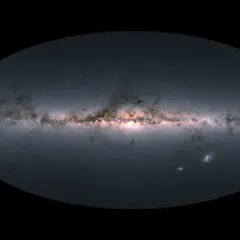
Floating crystals can pause the stellar aging process, providing a final energy source to otherwise dead stars.
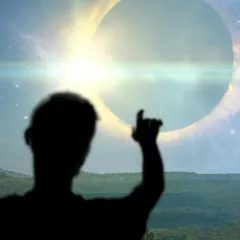
Eclipses have inspired myths, predictions and scientific discoveries. The total solar eclipse occurring on April 8 provides a once-in-a-lifetime opportunity to engage with science and the cosmos.

Deep-sea sediments show how the changing orbits of Earth and Mars are linked to past global warming and the speeding up of deep-ocean eddies.
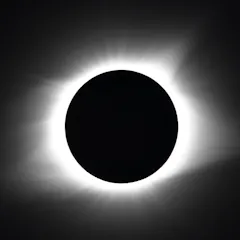
Many people will see a dazzling eclipse this April, but these events are possible only because of the sizes and precise distances between Earth, the Moon and the Sun.
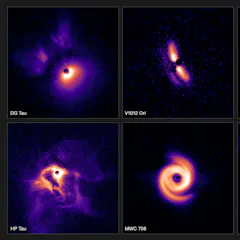
Astronomers have spotted a surprisingly diverse set of planet-forming disks.
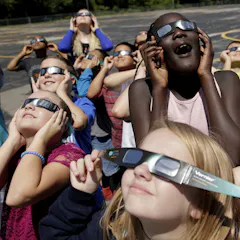
Now’s the time to get your hands on a pair of eclipse glasses in preparation for April’s display of celestial wonder.
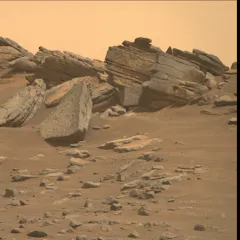
Determining whether or not life exists on another planet is an extraordinarily complicated – and expensive – scientific endeavor.
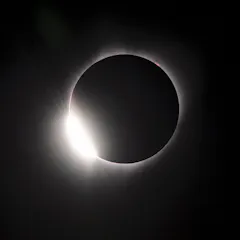
Mentions of total solar eclipses in ancient history help researchers pinpoint precise dates of notable events.
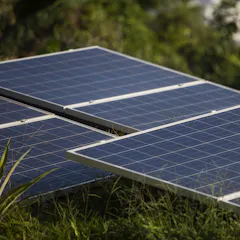
When the Moon blocks the Sun during an eclipse, utility suppliers have to pull power from the grid to make up for gaps in solar energy.
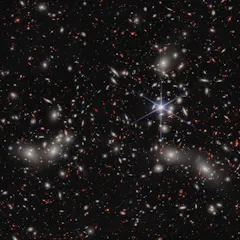
With the help of a magnifying glass 4 million lightyears wide, astronomers may have solved the riddle of what burned away the hydrogen fog that pervaded the early universe.
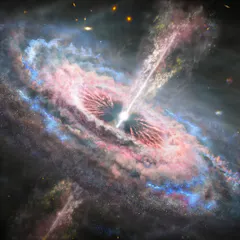
The discovery raises big questions about widely accepted models of galaxy formation.
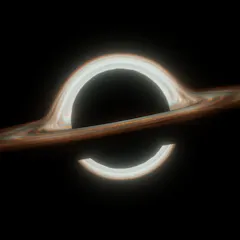
The extreme object could tell us more about the environment around black holes.
Top contributors
-

Professor (Astrophysics), University of Southern Queensland
-
Senior Curator (Astronomy), Museums Victoria Research Institute; The University of Melbourne
-
Associate Professor in Astronomy, Monash University
-
University Distinguished Professor of Astronomy, University of Arizona
-
Associate Professor, School of Physics, The University of Melbourne
-
Professor of Astrophysics, University of Sydney
-
Professor, Radio Astronomy, University of Sydney
-
Honorary Fellow, Space and Astronomy, CSIRO; Western Sydney University
-
John Curtin Distinguished Professor (Radio Astronomy), Curtin University
-
Pro Vice-Chancellor Flagship Initiatives, Swinburne University of Technology
-
Postdoctoral Researcher in Radio Astronomy, University of Sydney
-
Senior Lecturer in Physics, Nottingham Trent University
-
Associate Dean of Innovation and Engagement, Swinburne University of Technology
-
Lecturer in Astronomy, Nottingham Trent University
-
Dean of Science, University of California, Santa Cruz