

Comet Tsuchinshan-ATLAS is one of 2 comets from the Oort Cloud passing by Earth in October 2024.
Articles on Astronomy
Displaying 161 - 180 of 1002 articles
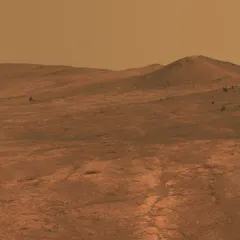
Before sending humans to Mars, NASA will first return humans to the Moon’s surface to test its technology and train astronauts.

Earth’s tilt means the Sun both rises earlier and sets later as we head towards summer.
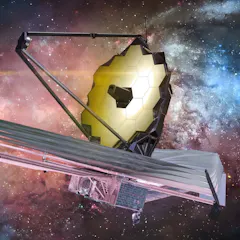
Some of the earliest galaxies found with JWST are also the brightest. That’s a problem for our ideas about the universe.
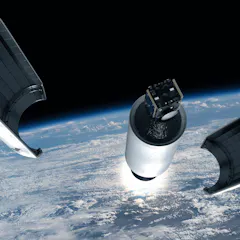
In 2022, a probe was sent crashing into an asteroid as part of a “planetary defence” test. This Monday, the second part of the mission flies off to study the consequences of the impact.
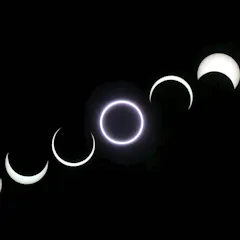
Argentina and Chile will see the ‘ring’, but other regions will see a partial eclipse.
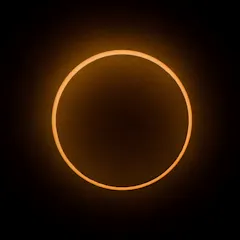
Parts of South America, the Pacific and Antarctica are under the path of an annular eclipse.

CubeSats have already visited the Moon and Mars and are key components of upcoming deep space missions.
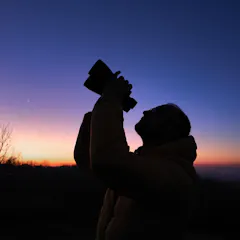
Comet C/2023 A3 (Tsuchinshan-ATLAS) is expected to be the brightest spectacle of 2024. Our charts will help you find it in the night sky.
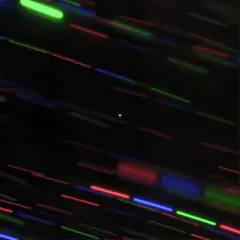
A large space rock will be temporarily captured by Earth’s gravity throughout October and November.

The Hubble tension has been described as a “crisis” for cosmology. Can it be resolved?
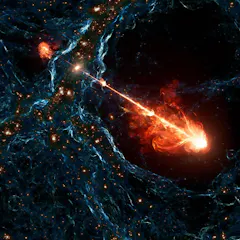
Astronomers have found a true colossus of a jet in the night sky, over 100 times larger than our galaxy. It’s almost perfectly straight, which presents a puzzle.
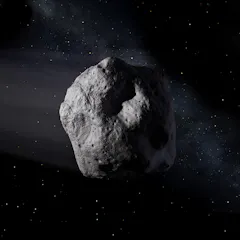
This month, they spotted just the ninth asteroid to be detected before impact with Earth.
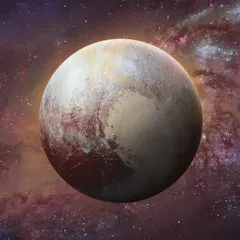
A South African team had a rare chance to capture information about Pluto’s atmosphere.
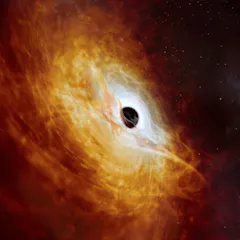
These small galaxies are either crammed with stars or they host gigantic black holes. The data astronomers have collected continues to puzzle them.
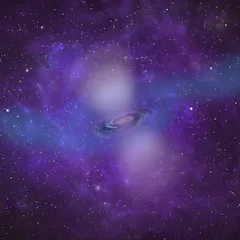
Today we’re able to finally reveal the first detailed picture of the gas shroud around a galaxy, extending 100,000 light years out into ‘empty’ space.
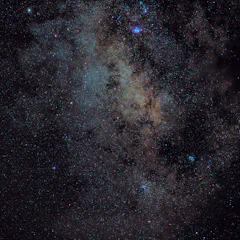
While space is mostly empty, it does have some matter and particles spread throughout it.
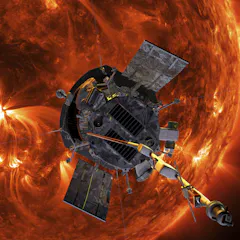
For years, researchers have wondered what energy source allows the solar wind − a projection of charged particles from the Sun − to rush by at hundreds of miles a second.

What’s so special about a supermoon? Hardly anything. There are better things to observe in the night sky, according to a professional astronomer.
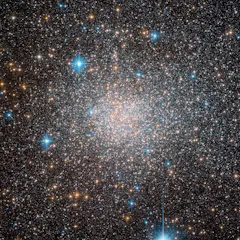
Space magnetism scrambles the paths of the universe’s most wayward particles – and scientists are finally discovering exactly how much.
Top contributors
-

Professor (Astrophysics), University of Southern Queensland
-
Senior Curator (Astronomy), Museums Victoria Research Institute; The University of Melbourne
-
Associate Professor in Astronomy, Monash University
-
University Distinguished Professor of Astronomy, University of Arizona
-
Associate Professor, School of Physics, The University of Melbourne
-
Professor of Astrophysics, University of Sydney
-
Professor, Radio Astronomy, University of Sydney
-
Honorary Fellow, Space and Astronomy, CSIRO; Western Sydney University
-
John Curtin Distinguished Professor (Radio Astronomy), Curtin University
-
Pro Vice-Chancellor Flagship Initiatives, Swinburne University of Technology
-
Postdoctoral Researcher in Radio Astronomy, University of Sydney
-
Senior Lecturer in Physics, Nottingham Trent University
-
Associate Dean of Innovation and Engagement, Swinburne University of Technology
-
Lecturer in Astronomy, Nottingham Trent University
-
Dean of Science, University of California, Santa Cruz