
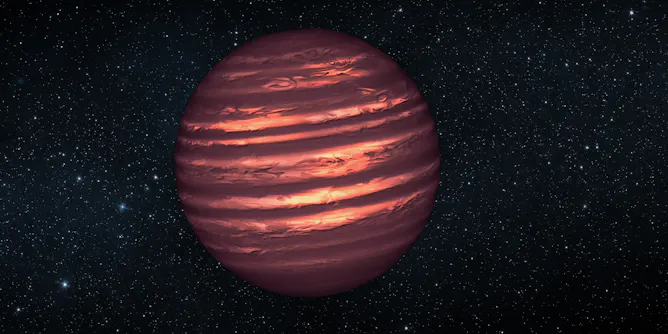
A failed star just taught us something new about the search for alien life.
Articles on Astronomy
Displaying 81 - 100 of 1002 articles
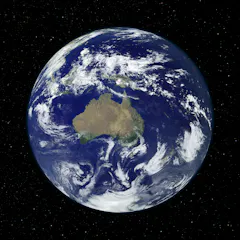
Every single day, space technology impacts our lives. But a new report reveals gaps between what Australians think and what they know about space.

New radio astronomy results reveal how galaxies exchange gas with the intergalactic medium – the raw material for stars and the key to galactic evolution.
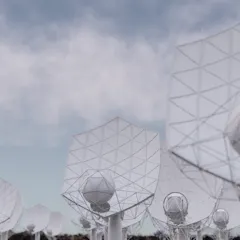
The world’s largest space telescope, comprising thousands of antennae in the southern hemisphere, will generate massive amounts of data — some of which will be processed in Canada.
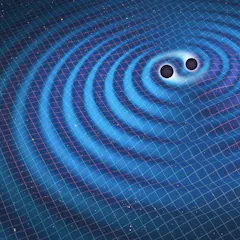
A decade after the first discovery, scientists have used these waves to find a unique merger, a massive binary system and a crystal-clear gravitational wave signal.
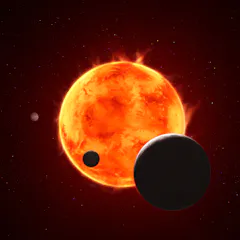
The largest telescope in space has been trained on a rocky exoplanet.
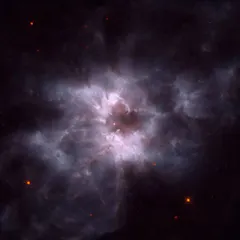
Could tiny stars a fraction the size of our solar system’s Sun have habitable planets orbiting them? A new study says it’s possible.
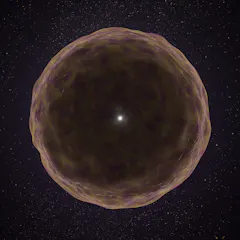
The bright explosion revealed its internal structure.
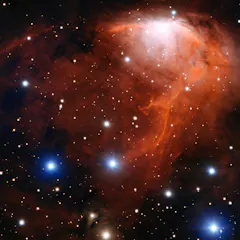
Two new studies challenge scientists’ previous theories on how the very first stars in the universe formed.
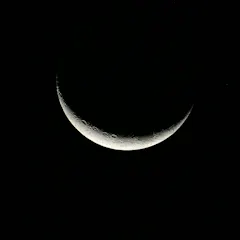
The Moon will indeed be black, kind of. But that’s not why you should look up this weekend.
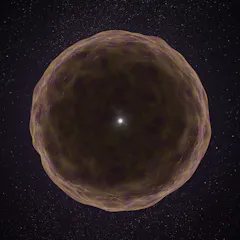
An ‘extremely stripped supernova’ confirms the existence of a key feature of physicists’ models of how stars produce the elements that make up the Universe.
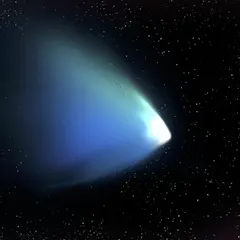
If you’re like most people, you’ve never heard of it. Meet the ringed asteroid-comet hybrid prowling the outer reaches of the Solar System.
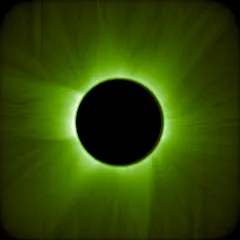
This solar eclipse was created by 2 satellites flying in formation, allowing astronomers to photograph the Sun’s corona.
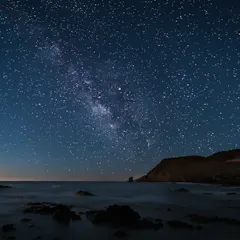
Some observatories that used to be dark and remote are now adjacent to bright urban centers. And sending all telescopes into space isn’t a viable solution.

The debate about an undiscovered planet X or planet 9 has been going on for more than 100 years.
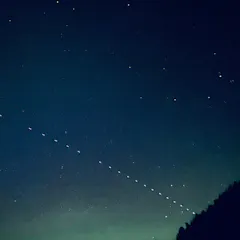
Streaks from satellites are disrupting observations by professional and amateur astronomers.
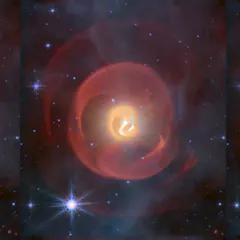
The stars are wreathed in a huge spiral of dust, like a snake eating its own tail.
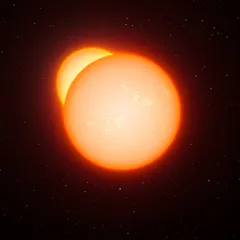
It takes a supercomputer weeks to output the properties of one stellar binary. A new study shows AI can do it in a fraction of the time.
If aliens did a flyby through the Solar System, would we even realise?
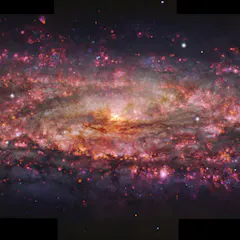
Researchers stitched together hundreds of images from the Very Large Telescope to form a breathtaking photo of a nearby galaxy.
Top contributors
-

Professor (Astrophysics), University of Southern Queensland
-
Senior Curator (Astronomy), Museums Victoria Research Institute; The University of Melbourne
-
Associate Professor in Astronomy, Monash University
-
University Distinguished Professor of Astronomy, University of Arizona
-
Associate Professor, School of Physics, The University of Melbourne
-
Professor of Astrophysics, University of Sydney
-
Professor, Radio Astronomy, University of Sydney
-
Honorary Fellow, Space and Astronomy, CSIRO; Western Sydney University
-
John Curtin Distinguished Professor (Radio Astronomy), Curtin University
-
Pro Vice-Chancellor Flagship Initiatives, Swinburne University of Technology
-
Postdoctoral Researcher in Radio Astronomy, University of Sydney
-
Senior Lecturer in Physics, Nottingham Trent University
-
Associate Dean of Innovation and Engagement, Swinburne University of Technology
-
Lecturer in Astronomy, Nottingham Trent University
-
Dean of Science, University of California, Santa Cruz